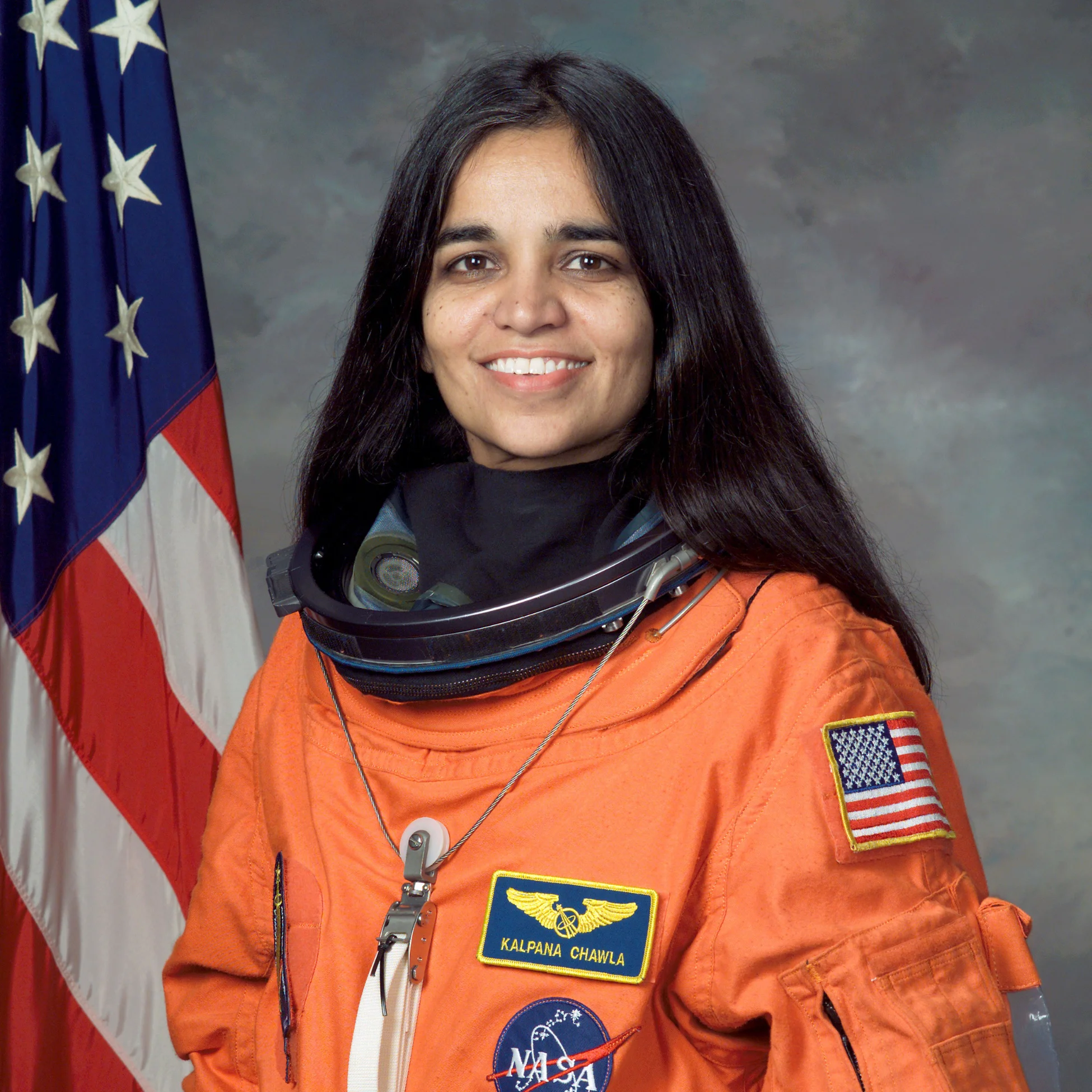
Kalpana Chawla, the pioneering astronaut, broke barriers and inspired generations to reach for the stars.
Quick Summary
Full Name: Kalpana Chawla
Born: 17th March 1962, Karnal, Haryana, India
Died: 1st February 2003, Space Shuttle Columbia disaster, Texas, USA
Profession: Astronaut, Aerospace Engineer
Known As: “India’s First Woman in Space”
Career Span: 1982 – 2003
Key Contributions:
First woman of Indian origin to go to space (STS-87, 1997) and second space mission STS-107 (2003).
Contributed to aerospace engineering projects at NASA, including satellite deployment and research experiments.
Inspired millions, especially women, to pursue careers in science, engineering, and space exploration.
Posthumously awarded the Congressional Space Medal of Honor (2004) and Padma Shri (1998).
Quote:
“The path from dreams to success does exist. May you have the vision to find it, the courage to get onto it, and the perseverance to follow it.” — Kalpana Chawla
Early Life
Kalpana Chawla, remembered as India’s first woman astronaut in space, was born on 17 March 1962 in Karnal, Haryana, India. Her parents, Banarasi Lal Chawla and Sanjyothi Chawla, provided her with a nurturing environment that encouraged curiosity and education. From an early age, Kalpana displayed an unusual fascination with the sky and airplanes. She would spend hours watching planes soar above Karnal and dreamed of one day touching the stars.
Growing up in a modest household, Kalpana’s determination set her apart. She attended Tagore Bal Niketan School and later pursued aeronautical engineering at Punjab Engineering College, Chandigarh, where she became one of the few female students in her batch. Her professors noted her relentless drive, precision in problem-solving, and a vision that extended beyond the classroom.
Despite societal expectations for women during that time, Kalpana’s family supported her ambitions. Her decision to pursue a career in aviation and space sciences was bold and inspiring for many young girls across India.
Journey to NASA
Kalpana’s academic brilliance soon took her to the United States. She earned a Master of Science degree in Aerospace Engineering from the University of Texas at Arlington (1984) and later completed a Ph.D. in Aerospace Engineering from the University of Colorado Boulder (1988).
Her journey was not easy. As an international student, Kalpana faced cultural differences, financial challenges, and rigorous academic demands. Yet, her determination never wavered. She often spoke about how the library became her second home, where she devoured books on flight dynamics, computational fluid dynamics, and spacecraft design.
In 1988, she began working at NASA’s Ames Research Center, contributing to aerodynamics research. Soon after, in 1991, Kalpana became a naturalized U.S. citizen and applied to join NASA’s astronaut program. Out of thousands of applicants, she was selected in 1994 – a testament to her exceptional talent and perseverance.
Her selection made her a role model for millions in India and abroad, proving that dreams, when pursued with passion, can overcome all barriers.
Space Missions
First Spaceflight – STS-87 (1997)
Kalpana Chawla’s first journey into space was aboard the Space Shuttle Columbia (STS-87), which launched on 19 November 1997. She became the first Indian-born woman in space and only the second Indian overall, after Rakesh Sharma.
During this mission, Kalpana was responsible for deploying the Spartan Satellite, which was designed to study the outer layers of the Sun. Although a technical issue occurred during the deployment, Kalpana’s handling of the mission was praised.
The 16-day mission orbited the Earth 252 times and covered over 10.4 million kilometers. Kalpana’s calm, professional conduct won admiration from her colleagues and cemented her place in the history of space exploration.
Second Spaceflight – STS-107 (2003)
Kalpana’s second mission, STS-107, was launched on 16 January 2003, again aboard Columbia. The mission was dedicated to scientific experiments, with over 80 experiments in microgravity conducted across disciplines such as biology, physics, and material sciences.
Kalpana, as a mission specialist, played a vital role in ensuring the experiments ran smoothly. Her colleagues described her as hardworking, approachable, and passionate about learning. She often expressed her excitement about how the mission’s results could benefit humanity.
Unfortunately, this mission ended in tragedy. On 1 February 2003, as Columbia re-entered Earth’s atmosphere, it disintegrated due to damage caused during launch. Kalpana, along with six other crew members, lost their lives in this heartbreaking accident.
Tragic End
The Columbia disaster shook the world. Investigations later revealed that a piece of foam insulation from the external fuel tank had struck the shuttle’s left wing during launch, causing catastrophic damage that went unnoticed.
Kalpana’s death was not just a loss for India or NASA, but for the entire world of science and exploration. Her story became a symbol of both the dangers of space travel and the courage of those who dare to dream beyond Earth.
In India, the nation mourned deeply. Schools, streets, and even universities were named in her honor. Children carried her pictures in classrooms, and leaders spoke of her as an eternal symbol of courage and ambition.
Legacy
Kalpana Chawla’s legacy transcends her scientific contributions. She remains an icon of women’s empowerment, perseverance, and inspiration.
Inspiration for Women in STEM
Her journey from a small town in Haryana to outer space is often cited as an example for women aspiring to careers in science, technology, engineering, and mathematics (STEM). She broke stereotypes, proving that Indian women could excel in the toughest and most competitive fields.
Honors and Recognitions
- NASA has dedicated several research missions and scholarships in her memory.
- The Kalpana Chawla Government Medical College (Karnal, Haryana) was established in her honor.
- India’s first weather satellite series, METSAT, was renamed Kalpana-1 in 2002.
- The University of Texas at Arlington established the Kalpana Chawla Hall, a residence for female students in engineering and science.
- Numerous schools and institutions across India bear her name.
Inspiration in Popular Culture
Her life has been celebrated in documentaries, books, and films. For millions, she embodies the belief that “The sky is not the limit, it’s just the beginning.”
Conclusion
The biography of Kalpana Chawla is the story of a dreamer who looked up at the skies from Karnal and dared to believe she could touch the stars. She became not only the first Indian woman in space but also a global symbol of courage, determination, and the power of dreams.
Though her life ended tragically, her spirit continues to inspire generations. Every time a rocket launches or a young girl decides to become a scientist, Kalpana’s legacy shines on.
In her own words: “The path from dreams to success does exist. May you have the vision to find it, the courage to get on to it, and the perseverance to follow it.”
FAQ's
She was the first woman of Indian origin to travel to space and a NASA astronaut.
She first went to space on STS-87 in November 1997.
She tragically died along with six crew members during the Space Shuttle Columbia disaster (STS-107) in February 2003
She received the Padma Shri, NASA Space Flight Medal, and posthumously, the Congressional Space Medal of Honor.
She inspired millions, especially women, to pursue careers in science, technology, engineering, and space exploration.