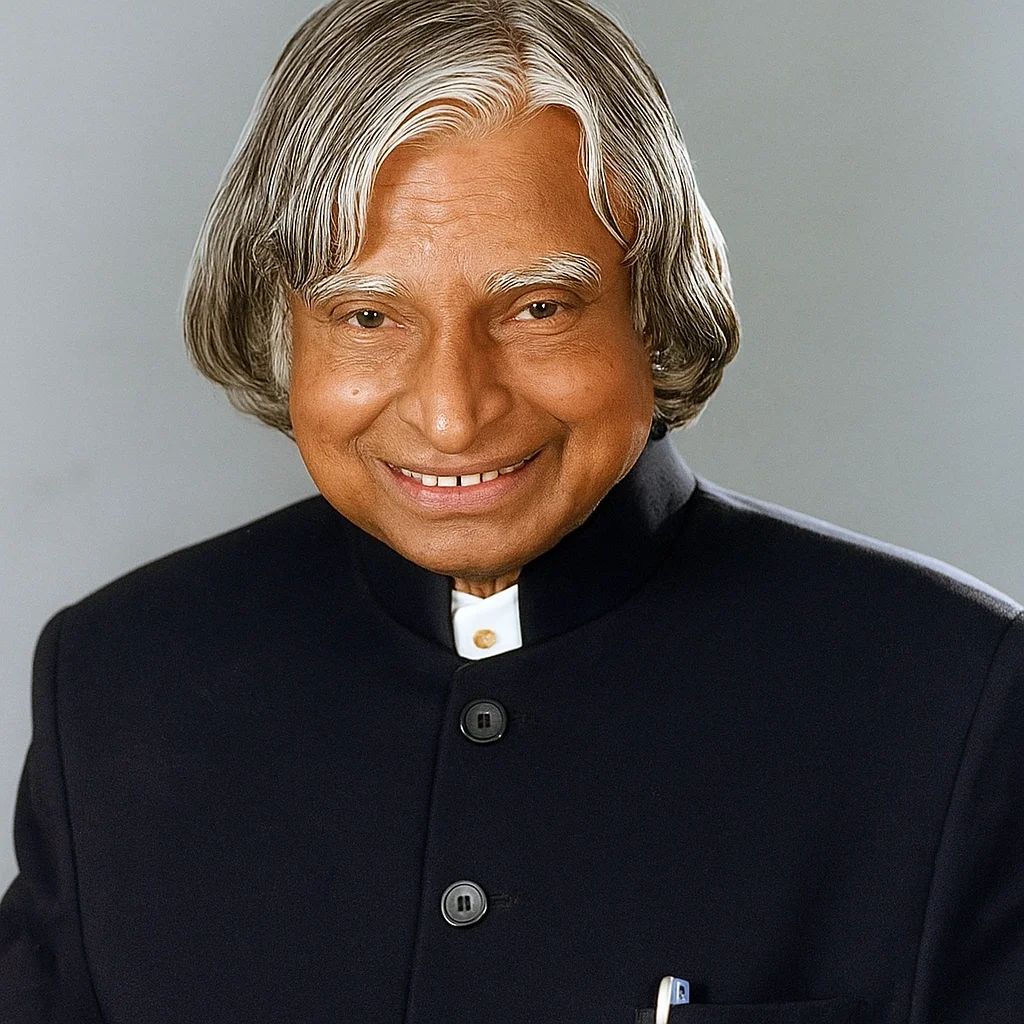
From a tea-seller to India’s longest-serving Prime Minister after Nehru, Narendra Modi embodies determination, vision, and transformative leadership
Quick Summary
Full Name: Avul Pakir Jainulabdeen Abdul Kalam
Born – Died: 15 October 1931 – 27 July 2015
Tenure(s) in Office: 11th President of India (2002–2007)
Political Party: Aerospace Scientist, Teacher, Author
Key Contributions:
Played key role in India’s missile development (Agni, Prithvi)
Led Pokhran-II nuclear tests (1998)
Advocated PURA (Providing Urban Amenities to Rural Areas)
Promoted education, youth empowerment, and innovation
Quote: “Dream, dream, dream. Dreams transform into thoughts and thoughts result in action”
Introduction: Dr. A.P.J. Abdul Kalam – India’s Pride
Dr. Avul Pakir Jainulabdeen Abdul Kalam, widely known as Dr. A.P.J. Abdul Kalam, was a visionary leader, scientist, and the 11th President of India. Revered as the “Missile Man of India” due to his pivotal role in India’s missile development, Dr. Kalam was also a beloved figure, often referred to as the “People’s President” for his humility, simplicity, and commitment to education and national development.
This individual profile provides an in-depth look into the life, achievements, and lasting legacy of Dr. A.P.J. Abdul Kalam. From his scientific breakthroughs to his inspirational speeches, this page is designed to give readers a comprehensive understanding of one of India’s greatest figures.
Early Life and Education
Dr. A.P.J. Abdul Kalam was born on 15th October 1931 in Rameswaram, a small town in Tamil Nadu. Coming from a modest background, his father, Jainulabdeen, was a boat owner, and his mother, Ashiamma, was a housewife. Despite financial hardships, Kalam was a diligent student, showing an early interest in science and mathematics.
He completed his schooling in Rameswaram and went on to study physics at St. Joseph’s College, Tiruchirappalli, graduating in 1954. Following this, he pursued aerospace engineering at the Madras Institute of Technology (MIT), where he displayed an early aptitude for aeronautics.
Key Facts:
- Born: 15th October 1931, Rameswaram, Tamil Nadu
- Education: Bachelor’s in Physics, St. Joseph’s College; Aerospace Engineering, MIT
- Early Ambition: Dreamt of becoming a fighter pilot; however, he narrowly missed his chance, placing ninth when only eight positions were available.
Journey in Pictures
1931
Young Dr. APJ Abdul Kalam from his college days
1960
Dr. APJ Abdul Kalam with Dr. Vikram Sarabhai in ISRO
1980-90's
DRDO archives, the first successful launch of Agni
1998
Dr. APJ Abdul Kalam and Atal Bihari Vajpayee during Pokhran-II test
2002
Dr. APJ Abdul Kalam Taking oath as President of India
2015
Dr. APJ Dbdul Kalam last lecture at IIM Shillong
Career in Science: The Missile Man of India
1. Early Career at DRDO
After completing his studies, Kalam joined the Defence Research and Development Organisation (DRDO) in 1960, where he worked on small helicopter projects. His passion for aerospace engineering and missile development took root during his time here.
2. Key Contributions to ISRO
Dr. Kalam’s career took a monumental turn when he moved to the Indian Space Research Organisation (ISRO) in 1969. Here, he played a pivotal role in developing India’s first satellite launch vehicle (SLV-III), which successfully deployed the Rohini satellite in orbit in 1980. This was India’s first major step toward becoming a space power.
3. Missile Development at DRDO
Returning to DRDO in the 1980s, Dr. Kalam spearheaded the Integrated Guided Missile Development Program (IGMDP). His work led to the development of several successful missiles, including Agni, Prithvi, Trishul, and Nag, which earned him the title “Missile Man of India.” These missile systems became a cornerstone of India’s defense capabilities, bolstering national security.
Key Scientific Contributions:
- SLV-III Project (ISRO): India’s first successful satellite launch vehicle.
- Agni and Prithvi Missiles: Strengthened India’s defense systems.
- Pokhran-II Nuclear Tests (1998): Kalam played a leading role in India’s second nuclear tests, marking a major milestone in India’s defense strategy.
The People's President: 11th President of India (2002-2007)
Dr. A.P.J. Abdul Kalam was elected as the 11th President of India in 2002. His tenure as president was marked by his humble, accessible, and inspirational approach to governance.
Often referred to as the People’s President, Kalam used his office to inspire the nation, particularly its youth, through speeches, books, and interactions.
Kalam’s focus during his presidency extended beyond politics. He remained committed to education, science, and technology and encouraged young minds to dream big. His famous speeches and books, such as “Wings of Fire” and “Ignited Minds,” continue to inspire millions of Indians.
Unlike many presidents, Kalam was a frequent visitor to schools, universities, and institutions across the country. His presidency saw him establish a connection with the masses that few leaders could achieve, reflecting his genuine concern for the common people.
Key Achievements as President:
- Advocacy for Education: Dr. Kalam believed that the future of India lay in the hands of its youth and often emphasized the importance of education and innovation.
- Accessibility to the People: Known for being approachable, Dr. Kalam connected with citizens from all walks of life, regardless of social or economic status.
- Vision for India 2020: Dr. Kalam envisioned India becoming a developed nation by 2020, and his plans outlined steps for sustainable growth, technology, and social welfare.
Post-Presidency and Contributions to Education
After completing his term as president, Dr. Kalam dedicated himself to academia, serving as a visiting professor at several prestigious institutions, including the Indian Institute of Science and the Indian Institute of Technology. His engagements involved lectures, inspiring talks, and initiatives to foster innovation among the younger generation.
Kalam’s dream of an India powered by innovation led him to establish multiple programs focused on encouraging scientific research and leadership development in young Indians. His “What Can I Give” movement was aimed at instilling a sense of social responsibility and contributing to the nation’s growth.
Key Contributions Post-Presidency:
- Educational Reforms: Kalam engaged extensively with students, encouraging scientific research and leadership development.
- Books and Publications: Kalam authored several books that inspired millions, including “Wings of Fire” (his autobiography), “Ignited Minds,” and “A Manifesto for Change.”
Dr. Kalam’s Legacy and Lasting Impact
Dr. A.P.J. Abdul Kalam’s sudden demise on 27th July 2015 left the nation in mourning. He collapsed while delivering a lecture at the Indian Institute of Management, Shillong, where he was engaging with students on his favorite topic—“Creating a Livable Planet Earth.” His death marked the end of an era, but his legacy continues to live on in the hearts and minds of millions.
His contributions to India’s scientific community, his leadership as president, and his dedication to education and youth empowerment have left an indelible mark on the country.
Legacy in Frames
Scientific Legacy: Father of India’s missile programme, pivotal in nuclear capability
Educational Inspiration: Inspired millions of students through books like Wings of Fire and lectures
Leadership Style: Known as the “People’s President” for his accessibility and humility
National Development Vision: PURA model and India 2020 vision document
Latest Facts and Developments
1. India’s Space Program: Dr. Kalam’s contribution to India’s space and missile programs continues to influence current developments. As of 2023, India’s space agency ISRO has achieved several milestones, including the success of Chandrayaan-3.
2. Memorials and Institutions: Several institutions have been named in his honor, including the Dr. A.P.J. Abdul Kalam Memorial in Rameswaram, Tamil Nadu, and various educational scholarships and programs that support the underprivileged.
3. Recognition: Dr. Kalam was posthumously awarded several honors, including initiatives like the Abdul Kalam National Memorial and academic programs established in his name.
Modi in Contemporary Context
Dr. A.P.J. Abdul Kalam is remembered not just as a scientist or a President, but as a teacher and visionary who touched lives across generations. His speeches and books continue to inspire students, innovators, and leaders worldwide. Today, he stands as a symbol of integrity, simplicity, and the boundless power of education and dreams.
Conclusion - Dr. A.P.J. Abdul Kalam – A True Indian Icon
Dr. A.P.J. Abdul Kalam’s life story is one of dedication, resilience, and an unwavering commitment to the nation. His journey from a humble background to becoming one of India’s most revered figures serves as an inspiration for generations. His contributions to science, technology, and education, along with his enduring legacy as the People’s President, truly make him a shining example of India’s pride—a man who continues to ignite minds across the nation.
FAQ's
He pursued physics at St. Joseph’s College and later studied aerospace engineering at MIT in Chennai.
Dr. Kalam led the development of key missile systems under the IGMDP, including Agni and Prithvi, significantly strengthening India’s defense capabilities.
Dr. Kalam played a pivotal role in India’s Pokhran-II nuclear tests in 1998, cementing India's status as a nuclear power.
His humility, accessibility, and genuine commitment to the nation’s youth and education earned him this title.
Dr. Kalam’s India Vision 2020 focused on transforming India into a developed nation through technological advancement, education, and sustainable growth.
Dr. Kalam’s major contributions include his role in India’s missile development, nuclear tests, and his presidency, during which he inspired millions, particularly the youth
His leadership in the SLV-III program and his work at ISRO and DRDO laid the foundation for India’s modern space program, making him a key figure in its success.
His humility, accessibility, and focus on education and the common people earned him
this title.