
1
Author of the Aryabhatiya
Author of the Aryabhatiya forms part of Aryabhata’s wider contribution to Indian science, technology or public life.
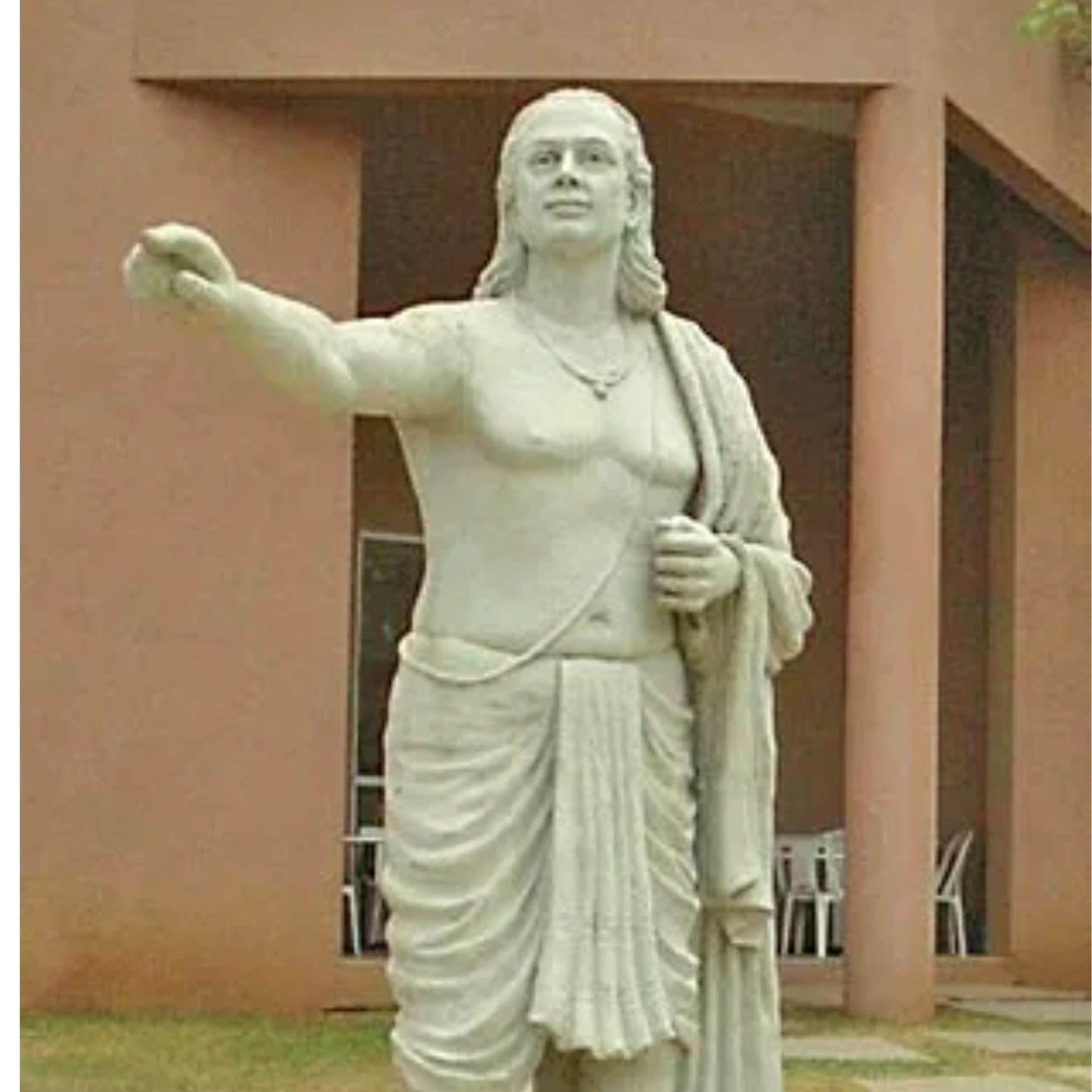
Writing in the fifth century, Aryabhata developed influential methods in arithmetic, algebra, trigonometry and astronomy, leaving a scientific legacy that travelled far beyond his own era.
Aryabhata (476–550 CE) was one of the greatest mathematicians and astronomers of ancient India. His pioneering contributions transformed the scientific understanding of mathematics and astronomy during the classical age. At a time when Europe was still in the early medieval period, Aryabhata was calculating the value of pi, proposing that the Earth rotates on its axis, and accurately describing eclipses. His ideas went far beyond his time and laid the foundation for centuries of advancements in both Indian and global science.
Aryabhata was born in 476 CE, most likely in Kusumapura (modern-day Patna, Bihar) , which was a hub of learning under the Gupta Empire , known as India’s golden age. Although detailed records of his personal life are scarce, scholars believe that Aryabhata pursued his studies at the renowned Nalanda University , a global center of knowledge.
From a young age, Aryabhata displayed an extraordinary ability in mathematics and observation of celestial bodies. His education combined Sanskrit scholarship, mathematical training, and astronomical studies , giving him a holistic foundation to pursue original discoveries.
Aryabhata was born in the late fifth century and became one of the most important mathematician-astronomers of the classical Indian tradition.
At about age 23, he composed the Aryabhatiya, a compact mathematical and astronomical text.
His work included algorithms for arithmetic, algebraic problems and highly accurate approximations.
Aryabhata developed methods and tables related to sine functions that became influential in later astronomy.
He explained the apparent daily motion of the stars as a consequence of Earth’s rotation.
Aryabhata’s ideas influenced later Indian scholars and entered broader mathematical traditions through translation and commentary.
The Aryabhatiya is remarkable for compressing sophisticated mathematical and astronomical ideas into concise verse. Its techniques, terminology and calculations became a foundation for later scholars who expanded, corrected and transmitted Aryabhata’s work.
Science • Innovation • IndiaAuthor of the Aryabhatiya forms part of Aryabhata’s wider contribution to Indian science, technology or public life.
Major contributor to classical Indian astronomy forms part of Aryabhata’s wider contribution to Indian science, technology or public life.
Important early work in trigonometry forms part of Aryabhata’s wider contribution to Indian science, technology or public life.
Accurate approximation of pi forms part of Aryabhata’s wider contribution to Indian science, technology or public life.
Methods for solving indeterminate equations forms part of Aryabhata’s wider contribution to Indian science, technology or public life.
Enduring influence on later Indian mathematics forms part of Aryabhata’s wider contribution to Indian science, technology or public life.
The Aryabhatiya is remarkable for compressing sophisticated mathematical and astronomical ideas into concise verse. Its techniques, terminology and calculations became a foundation for later scholars who expanded, corrected and transmitted Aryabhata’s work.
Aryabhata’s importance lies in method rather than myth. He did not ‘invent zero’ in the modern popular sense, but his work belongs to the mathematical culture in which place-value notation and sophisticated computational methods developed.
Biographical and historical reference on Aryabhata.
View source →Institutional context for the history of Indian science.
View source →Historical mathematics reference.
View source →India’s first satellite was named Aryabhata in his honour.
View source →Writing in the fifth century, Aryabhata developed influential methods in arithmetic, algebra, trigonometry and astronomy, leaving a scientific legacy that travelled far beyond his own era.
Author of the Aryabhatiya, Major contributor to classical Indian astronomy, Important early work in trigonometry.
Aryabhata’s importance lies in method rather than myth. He did not ‘invent zero’ in the modern popular sense, but his work belongs to the mathematical culture in which place-value notation and sophisticated computational methods developed.
Sine tables, A rotating Earth, Transmission across cultures.
Help us improve the archive by suggesting reliable information or another Indian personality worth documenting.