
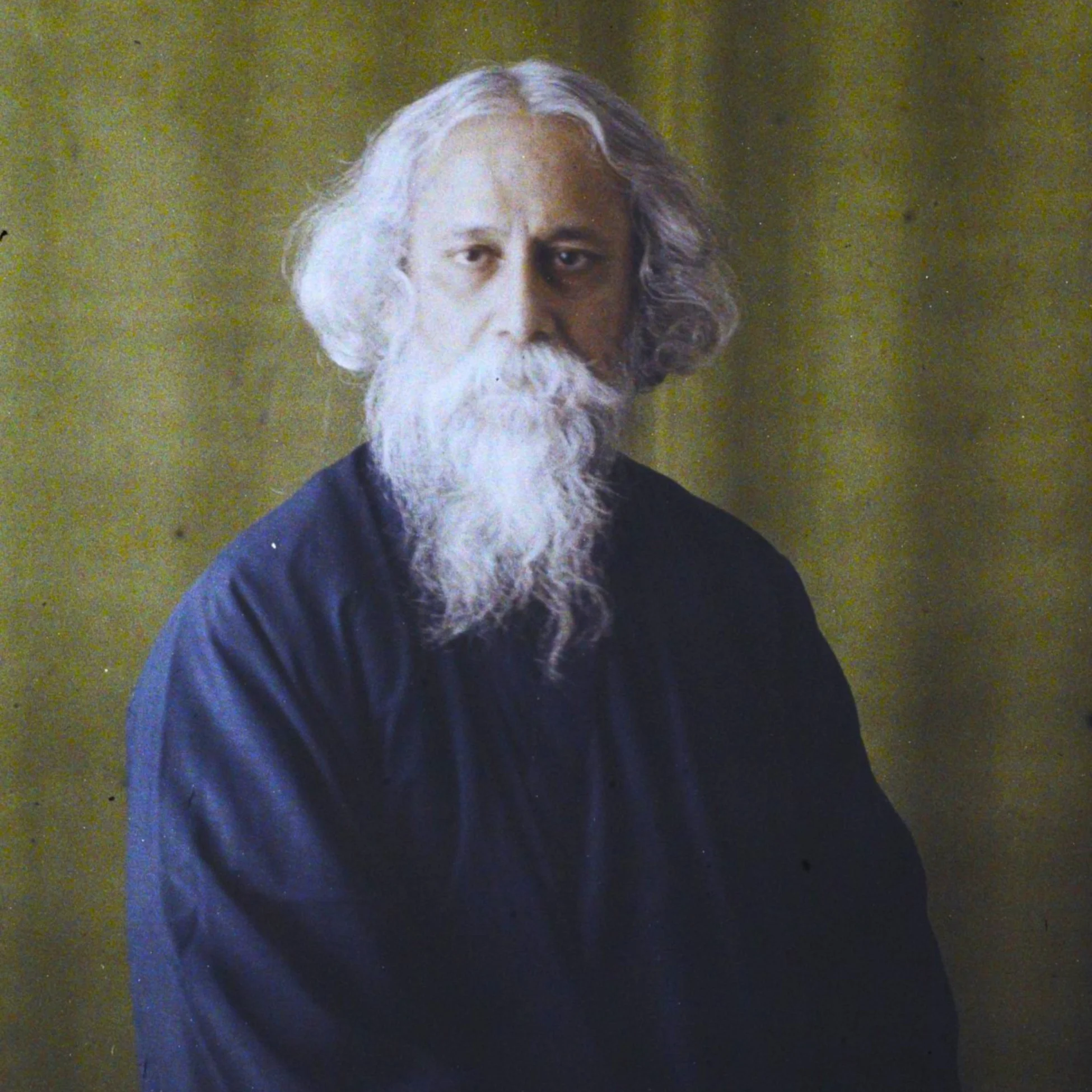
Rabindranath Tagore, India’s literary genius, inspired generations with his poetry, music, philosophy, and vision for education.
Quick Summary
Full Name: Rabindranath Tagore
Born: 7th May 1861, Kolkata, Bengal Presidency, British India (now West Bengal, India)
Died: 7th August 1941, Kolkata, India
Profession: Poet, Writer, Philosopher, Composer, Artist, Educationist
Known As: “Gurudev,” “Bard of Bengal”
Career Span: 1877 – 1941
Key Contributions:
First non-European to win the Nobel Prize in Literature (1913) for Gitanjali.
Composed India’s national anthem (Jana Gana Mana) and Bangladesh’s national anthem (Amar Sonar Bangla).
Authored thousands of poems, stories, essays, plays, and songs, influencing Indian literature and culture profoundly.
Founded Visva-Bharati University at Santiniketan, emphasizing holistic and global education.
Advocated for humanism, internationalism, and spiritual unity in his works.
Quote:
“You can’t cross the sea merely by standing and staring at the water.” — Rabindranath Tagore
Early Life
Rabindranath Tagore, often revered as Gurudev, was born on 7 May 1861 in Calcutta (now Kolkata) into the illustrious Tagore family. His father, Debendranath Tagore, was a philosopher and religious reformer, while his mother, Sarada Devi, passed away when Rabindranath was still very young.
The Tagore household was a hub of intellectual, cultural, and artistic exchange. Rabindranath grew up surrounded by literature, music, and art, which shaped his creative instincts from an early age. Unlike most children of his era, he did not attend conventional school. Instead, he was homeschooled, where he developed an interest in literature, philosophy, music, and nature.
As a teenager, Tagore began writing poetry, and by the age of 16, he had already published several works under the pseudonym “Bhanusimha.” His early poems displayed a depth and maturity far beyond his years, marking the beginning of a journey that would revolutionize Indian and world literature.
Literary Contributions
Rabindranath Tagore’s literary output was vast and diverse. He was not only a poet but also a novelist, short story writer, playwright, essayist, painter, and composer. His works combined elements of Indian tradition with universal humanism, making them timeless and relatable across cultures.
Poetry
Tagore’s poetry remains his most celebrated contribution. His anthology “Gitanjali” (Song Offerings), published in 1912, is considered a spiritual and literary masterpiece. The poems explore themes of divinity, nature, love, and human connection with the infinite.
Other major poetry collections include:
- Manasi (1890) – blending romanticism with philosophical insights.
- Sonar Tori (1894) – known
- Balaka (1916) – poems reflecting on modernity and the essence of time.
Novels and Short Stories
Tagore’s novels often dealt with the clash between tradition and modernity, freedom and societal expectations. Notable novels include:
- Gora – addressing nationalism and identity.
- Ghare-Baire (The Home and the World) – exploring love, politics, and patriotism.
- Chokher Bali – a tale of love and betrayal.
His short stories are regarded as some of the finest in world literature. Collections like Galpaguchchha revealed his mastery in capturing the lives of ordinary Indians with profound empathy.
Music and Songs
Tagore composed over 2,000 songs, collectively known as Rabindra Sangeet. These songs combined Indian classical traditions with folk melodies and remain deeply influential in Bengali culture. Remarkably, two of his compositions later became national anthems:
- “Jana Gana Mana” – the national anthem of India.
- “Amar Shonar Bangla” – the national anthem of Bangladesh.
Nobel Prize and Achievements
In 1913, Rabindranath Tagore became the first non-European to win the Nobel Prize in Literature for his translation of Gitanjali into English. The Swedish Academy praised his profound sensitivity, fresh imagery, and deeply spiritual vision.
This achievement not only elevated Tagore’s global reputation but also brought Indian literature onto the world stage. He became a cultural ambassador for India, traveling extensively across Europe, the United States, Latin America, and East Asia.
Tagore’s Nobel Prize was a landmark moment that challenged Western dominance in literature and highlighted the richness of Indian creativity.
Beyond the Nobel, he received numerous accolades, including honorary doctorates from Oxford University, Edinburgh University, and many others.
Social Reforms and Education
Tagore was more than a literary genius; he was also a social reformer, philosopher, and educationist.
Shantiniketan and Visva-Bharati University
In 1901, he founded a school in Shantiniketan, envisioning an education system that combined the best of Eastern and Western traditions. Unlike traditional rote-learning methods, his school emphasized creativity, freedom, and learning in harmony with nature.
In 1921, Shantiniketan evolved into Visva-Bharati University, which later attracted scholars and students from around the world. It became a center of cultural exchange, embodying Tagore’s philosophy of universalism and global unity.
Advocacy for Social Change
Tagore strongly opposed caste discrimination, child marriage, and rigid social norms. Through his writings and public speeches, he advocated for women’s empowerment, rural development, and a society based on equality and justice.
Although deeply patriotic, Tagore often criticized blind nationalism. He believed in universal humanism and warned against aggressive patriotism that could lead to conflict. His ideas continue to inspire debates on nationalism and global unity.
Encounters with World Leaders and Thinkers
Tagore’s global travels brought him in contact with some of the greatest minds of his time:
- Albert Einstein – with whom he discussed science, philosophy, and spirituality.
- Mahatma Gandhi – whom he deeply respected, although they often differed on issues of nationalism. It was Tagore who gave Gandhi the title “Mahatma.”
- W.B. Yeats – the Irish poet who helped introduce Tagore’s Gitanjali to the Western audience.
These interactions enriched his worldview and deepened his belief in cultural exchange and dialogue between civilizations.
Legacy
Rabindranath Tagore’s influence continues to resonate even today.
- His literary works remain part of school curricula across India and abroad.
- His songs and compositions are still sung in cultural and spiritual gatherings.
- His educational vision at Visva-Bharati continues to inspire progressive education.
- His humanist philosophy offers guidance in today’s world plagued by division and conflict.
Tagore passed away on 7 August 1941, leaving behind a legacy that transcends generations. He is remembered as India’s first Nobel Laureate, the Bard of Bengal, and the universal poet who bridged East and West.
Conclusion
The biography of Rabindranath Tagore is a journey through poetry, philosophy, music, education, and reform. He was not just a writer but a visionary who believed in the power of creativity and universal brotherhood.
His works continue to inspire millions across the globe, making him one of the greatest cultural icons in history. In every sense, Tagore’s life was a poem itself—sublime, eternal, and deeply human.
FAQ's
He is famous for his poetry, literature, music, and being the first non-European Nobel laureate in Literature.
He won the Nobel Prize in Literature in 1913 for Gitanjali.
Yes, he composed Jana Gana Mana, the national anthem of India.
It is the university founded by Tagore at Santiniketan, promoting holistic education and cultural exchange.
He was born on 7th May 1861 and passed away on 7th August 1941.