1930s
Theoretical Physics
Made important contributions to particle and cosmic-ray research.
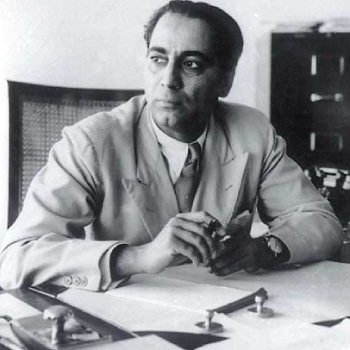
Theoretical physicist whose scientific work and institution-building helped create the foundations of India’s nuclear research programme and modern high-level physics.
Homi Jehangir Bhabha was born in Bombay in 1909 and studied at Cambridge, where he moved from engineering toward theoretical physics. His early research made important contributions to cosmic-ray and particle physics.
Returning to India during the Second World War, Bhabha joined the Indian Institute of Science in Bengaluru. He then helped establish the Tata Institute of Fundamental Research in 1945 as a centre for advanced research in physics and mathematics.
After independence, he became the first chairman of the Atomic Energy Commission. His vision linked fundamental science, nuclear research and national development, giving India a scientific institutional base that continued to expand after his death.
Selected milestones that place the biography in its wider historical setting.
Homi Jehangir Bhabha was born into a prominent Parsi family.
He developed his career in theoretical physics and cosmic-ray research.
Bhabha joined IISc in Bengaluru and began building a research programme in India.
With support from the Tata Trusts, he helped establish the Tata Institute of Fundamental Research.
Bhabha became the first chairman of India’s Atomic Energy Commission.
He guided the growth of India’s nuclear and high-energy research institutions.
Bhabha died near Mont Blanc on 24 January 1966.
Bhabha understood that individual scientific talent was not enough. India needed permanent institutions, laboratories and training systems if advanced research was to become sustainable.
TIFR and the atomic-energy establishment turned that belief into a long-term national scientific infrastructure.
TIFR • Atomic Energy • Fundamental ScienceA concise selection rather than a complete historical record.
Made important contributions to particle and cosmic-ray research.
Helped establish the Tata Institute of Fundamental Research.
Became its first chairman.
Argued for major investment in advanced science.
Created structures that outlived his own career.
Helped shape India’s early nuclear-science programme.
Bhabha believed advanced science should not be treated as a luxury for a developing country. He saw research capacity as essential to long-term technological independence.
That approach placed laboratories, universities and scientific training inside a broader nation-building project.
TIFR and India’s atomic-energy institutions remain among the most visible parts of Bhabha’s legacy.
His influence survives not simply through scientific papers but through the organisational structures he helped create.
Key facts on this page are supported by institutional, archival and reference sources.
Institution founded under Bhabha’s leadership and a key source on his scientific legacy.
View source →Official portal for India’s atomic-energy programme and institutional history.
View source →Biographical reference on his scientific career and institution-building.
View source →Quick answers about the life, movement and historical legacy.
He was born on 30 October 1909 in Bombay.
He helped establish the Tata Institute of Fundamental Research in 1945.
He became the first chairman of India’s Atomic Energy Commission in 1948.
He worked in theoretical physics, including particle interactions and cosmic rays.
He died in an air crash near Mont Blanc on 24 January 1966.
Help us improve the archive by suggesting reliable information or another Indian personality worth documenting.