1926
Naujawan Bharat Sabha
Helped organise youth around anti-colonial politics.
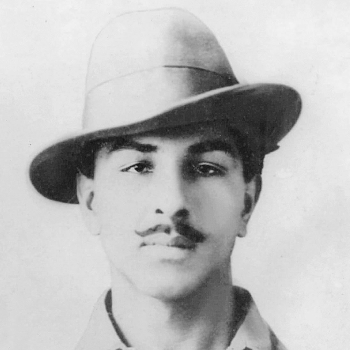
Revolutionary activist and writer whose political actions, prison protest and execution at the age of 23 made him one of the most powerful symbols of India’s anti-colonial struggle.
Bhagat Singh was born in 1907 into a politically active Punjabi family. The Jallianwala Bagh massacre, anti-colonial agitation and revolutionary politics strongly shaped his generation and his early political thinking.
He became associated with the Hindustan Socialist Republican Association and took part in revolutionary actions including the killing of J. P. Saunders in 1928 and the Central Legislative Assembly bombing with Batukeshwar Dutt in 1929.
After deliberately courting arrest, Singh used the courtroom, prison hunger strike and political writing as platforms. His execution with Rajguru and Sukhdev on 23 March 1931 made him a martyr, while his essays preserved a more complex legacy of socialism, secularism and anti-imperial thought.
Selected milestones that place the biography in its wider historical setting.
Bhagat Singh was born into a family already connected with anti-colonial politics.
The massacre became one of the formative events in his political world.
He helped organise young activists and connect nationalism with social change.
Singh and associates targeted J. P. Saunders after the death of Lala Lajpat Rai.
With Batukeshwar Dutt, he threw low-intensity bombs in the Central Legislative Assembly and surrendered.
The protest over treatment of Indian prisoners drew national attention.
Bhagat Singh, Rajguru and Sukhdev were executed on 23 March 1931.
Bhagat Singh understood that political impact depended on communication as much as clandestine action. His Assembly protest was followed by deliberate arrest, statements and a prison hunger strike designed to reach a much wider public.
Those choices transformed him from an underground activist into a national political symbol before his execution.
HSRA • Socialist Thought • MartyrdomA concise selection rather than a complete historical record.
Helped organise youth around anti-colonial politics.
Worked within a revolutionary organisation with an increasingly socialist orientation.
Took part in armed retaliation linked to Lala Lajpat Rai’s death.
Used a dramatic protest to publicise opposition to colonial laws.
Raised the issue of discriminatory treatment of Indian prisoners.
Left essays on revolution, socialism, religion and colonialism.
Bhagat Singh did participate in revolutionary violence, but his writings show that he did not equate revolution with indiscriminate violence.
By the end of his life he was thinking deeply about socialism, secularism, class and what freedom should mean beyond the transfer of political power.
His execution at 23 fixed Bhagat Singh in public memory as a symbol of youth, courage and sacrifice.
His writings ensure that his legacy is also intellectual, continuing to shape debates about nationalism, socialism, religion and political resistance.
Key facts on this page are supported by government, archival and institutional sources.
Government of India background on his life and revolutionary role.
View source →Ministry of Culture note on the iconic portrait and its role in public memory.
View source →Official short profile of Bhagat Singh from the freedom-movement series.
View source →Quick answers about the life, movement and historical legacy.
He was born on 28 September 1907 in Lyallpur district, Punjab, then part of British India.
He was associated with the Hindustan Socialist Republican Association, or HSRA.
The 1929 action was designed as a dramatic political protest; they then surrendered to use the trial as a public platform.
He protested discriminatory prison conditions and demanded better treatment for Indian political prisoners.
He was executed with Rajguru and Sukhdev on 23 March 1931 in Lahore.
Help us improve the archive by suggesting reliable information or another Indian personality worth documenting.