
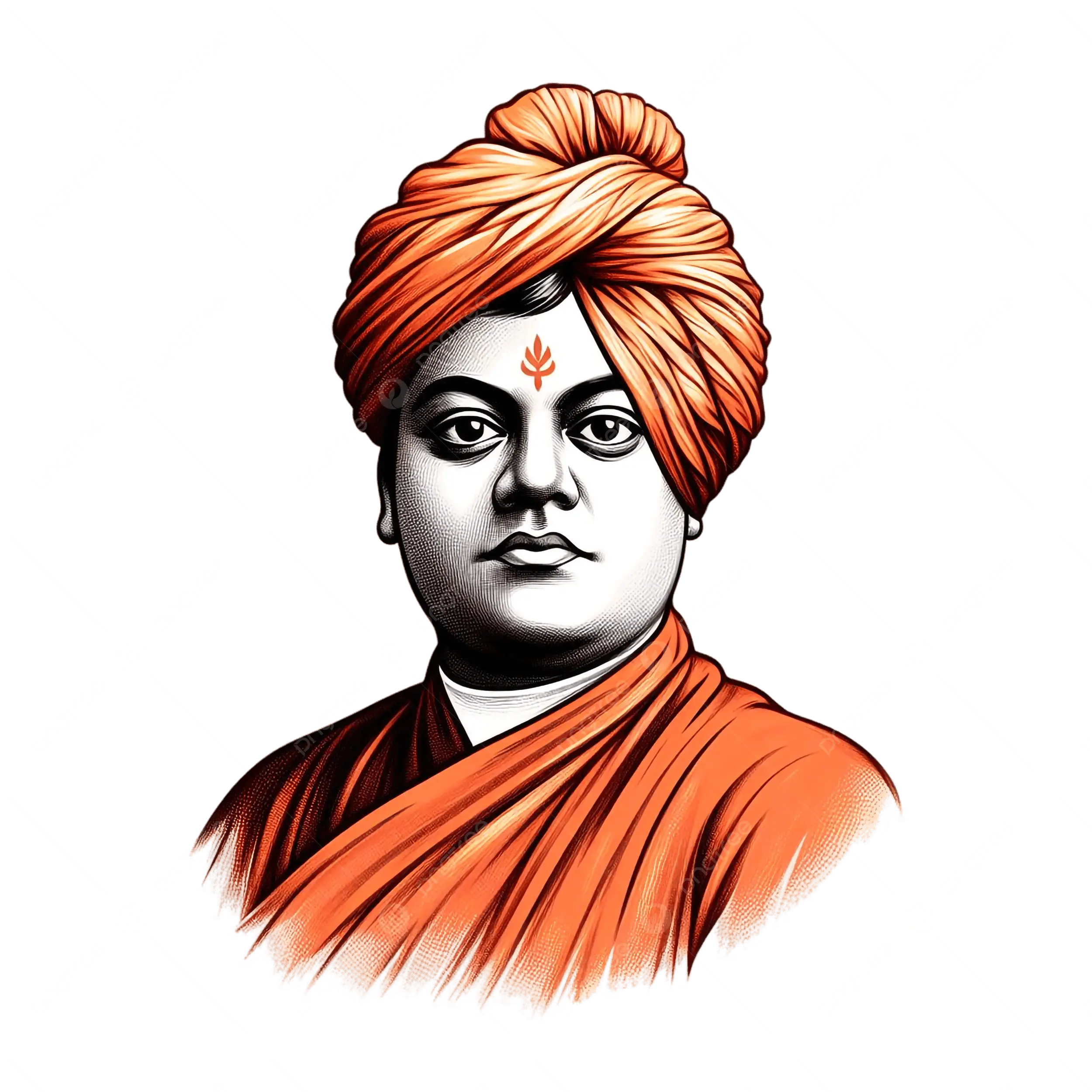
Swami Vivekananda, a visionary spiritual leader and social reformer, awakened India’s self-belief and shared its ancient wisdom with the world, leaving an enduring legacy of unity and national pride.
Swami Vivekananda (Born Narendranath Datta)
Born: January 12, 1863, in Calcutta (now Kolkata)
Tenure: Not applicable (spiritual leader, not a political tenure)
Party: Not applicable (spiritual leader, not affiliated with a political party)
Contributions:
- Introduced Hinduism to the Western world at the Parliament of the World’s Religions in Chicago (1893).
- Founded the Ramakrishna Mission for selfless service, education, and humanitarian work.
- Advocated for self-belief, inner strength, and unity in diversity among all religions.
- Championed education for empowerment and played a significant role in India’s national regeneration.
- Inspired industrialist Jamsetji Tata to establish research and education centers in India.
Quote: “Arise, Awake, and Stop Not Till the Goal is Achieved.”
Swami Vivekananda: A Beacon of Pride and Unity for India
Swami Vivekananda is a name that fills every Indian heart with pride. He was a great spiritual leader, a deep thinker, and a social reformer who helped India find its true self. He not only shared India’s ancient wisdom with the whole world but also lit a fire of self-belief and unity within our nation. This article will take you on a journey through his amazing life, from his early days to his global impact and the lasting lessons he left behind.
Early Life: The Making of a Seeker
Swami Vivekananda was born Narendranath Datta on January 12, 1863, in Calcutta (now Kolkata). It was a special day, the festival of Makar Sankranti. He came from a well-to-do Bengali family. His home was at 3 Gourmohan Mukherjee Street.
His father, Vishwanath Datta, was a smart lawyer who believed in new ideas. His mother, Bhubaneswari Devi, was a very religious and loving homemaker. These two different but important influences – his father’s logic and his mother’s faith – helped shape Narendranath into the person he became.
Even as a small boy, Narendra was drawn to spiritual things. He often sat quietly, meditating before pictures of gods and goddesses like Shiva, Rama, Sita, and Hanuman. He was also very interested in wandering holy men. But Narendra was also a very lively and sometimes mischievous child! His mother once famously said, “I prayed to Shiva for a son, and he has sent me one of his demons.” This shows his strong, spirited nature from a young age.
One amazing story from his childhood shows his courage. Once, while playing with his friends, Narendra saw a tiger that had escaped from a circus. Instead of running away like everyone else, Narendra stood still and watched the tiger calmly. His friends and even the circus trainers were amazed! This incident showed that he had courage and a calm mind even as a child. This is an “India Proud Moment” that tells us about the great leader he would become.
Narendranath’s school life started at eight years old in Ishwar Chandra Vidyasagar’s Metropolitan Institution. Later, he joined Presidency College and was the only student to get top marks in the entrance exam. This shows how smart he was. But for him, learning was not just about books; it was about finding answers to life’s big questions. He struggled with deep thoughts and ideas, always searching for a way to connect science with spirituality. This search eventually led him to his great teacher, Ramakrishna.
The Path to Enlightenment: Meeting the Master
A big change in Narendranath’s life happened when he met Sri Ramakrishna, a wise priest at the Dakshineswar Kali Temple. This meeting was his “first break.” At first, Naren was a bit doubtful, but he was soon deeply moved by Ramakrishna’s spiritual experiences and teachings. This was a time of intense learning for Naren. He trained hard, questioned himself deeply, and let go of worldly desires.
After Ramakrishna passed away in 1886, Narendranath and other students decided to dedicate their lives to God, becoming monks. This period also brought challenges, like money troubles and the huge responsibility of carrying on their teacher’s wisdom in an uncertain world.
Discovering India’s Soul: The Wandering Monk
After Ramakrishna’s passing, Narendranath became a ‘Parivrajaka,’ a wandering monk. He traveled all over India, often with very little money and no fixed home. This was a very important time for him. He walked across the country, saw many different cultures, and learned about different ways of thinking. Most importantly, he saw with his own eyes the difficult lives and suffering of the Indian people under British rule.
This long journey touched his heart deeply. It made him even more determined to help his countrymen and share India’s special spiritual knowledge with the rest of the world. During these travels, the Maharaja of Khetri gave him the name ‘Vivekananda,’ which means “the bliss of discerning wisdom.”
A Roaring Ascent: Conquering the World Stage
Swami Vivekananda‘s journey to fame began with a brave decision: to represent Hinduism at the Parliament of the World’s Religions in Chicago in 1893. This was a true “India Proud Moment” that put India on the global map!
He arrived in Chicago between September 11-27, 1893, and gave a powerful and beautiful speech that started with the famous words, “Sisters and brothers of America…” His words captured the hearts of about 5,000 people there. An American newspaper praised him, calling him “an orator by divine right and undoubtedly the greatest figure at the Parliament.”
His seven-minute speech changed how the world saw India. He introduced Hinduism to the West in a very positive way, talking about acceptance and respect for all religions. This speech made people all over the world interested in Indian philosophy, Yoga, and meditation.
For the next four years, Swami Vivekananda traveled and gave talks across the United States, the United Kingdom, and Europe. He shared the ideas of Vedanta and Yoga. He even started the Vedanta Society in New York and San Francisco, which helped spread Indian spiritual thought in the West. This time showed his great dedication, sharp mind, and wonderful speaking skills as he worked tirelessly to bring different cultures and religions closer.
Building a Brighter India: The Ramakrishna Mission
When Swami Vivekananda came back to India in 1897, he used his global fame to do good things for his country. On May 1, 1897, he started the Ramakrishna Mission. This was another huge “India Proud Moment” that changed many lives.
The Ramakrishna Mission had two main parts: the Ramakrishna Math, which was for monks to train spiritually, and the Ramakrishna Mission, which focused on helping people through social services, education, and humanitarian work. Its main idea was selfless service – helping others without wanting anything in return.
The Mission set up schools and training centers. For example, the Ramakrishna Mission Shilpavidyalaya (started in 1921) trained “hundreds of youth” in useful skills like becoming electricians, fitters, turners, and welders. This gave young people, especially from villages, important chances they might not have had otherwise. It helped them get good jobs and improved their lives by connecting rural India to modern industries.
Vivekananda also played a big part in bringing back Hindu traditions and helping Indian nationalism grow. He taught that helping society and getting a good education were important parts of spiritual life. He also spoke up for women’s rights.
It’s also interesting to know that during his trip to the West, Swami Vivekananda met Jamsetji Tata, a famous industrialist. Vivekananda inspired him to set up a research and education center in India and talked about building a steel factory. This shows how he helped lay the foundation for India’s important industries and education system.
His Enduring Voice: Core Beliefs & Message to Youth
Swami Vivekananda‘s ideas are like a constant source of strength and unity for India. His philosophy is rooted in the idea that there is a divine power in every person.
He strongly believed in Self-Belief and Inner Strength. He famously said, “He is an atheist who does not believe in himself.” He taught that “Strength is Life, Weakness is Death.” This means we must believe in ourselves and our own power.
He championed Unity in Diversity. Vivekananda always spoke about peace and harmony among all religions and people. He wanted everyone to respect and understand each other, which he saw as the base for a strong nation. His speech in Chicago was a great example of this idea of universal acceptance.
He believed in Service to Humanity (Karma Yoga). For him, being truly spiritual meant actively working to make the world better. He said, “The best way to serve God is to serve mankind.” This belief led to the Ramakrishna Mission, which helps people.
His Patriotism and National Regeneration were deep. He loved India very much and dreamed of a strong, self-reliant nation. He told his countrymen, “Believe in India faith. Be strong and hopeful and unashamed.” He filled Indians with a great sense of national pride. Mahatma Gandhi even said that after reading Vivekananda’s writings, his love for his country grew a thousand times.
He also believed in Education for Empowerment. He thought education should not just give information but should build character and give life skills, helping people realize their full potential and use it for the good of everyone.
Swami Vivekananda was an inspiring leader. He made his followers believe in themselves and encouraged them to grow. He was spiritual and had a clear vision for India’s future. He was also brave and strong, always saying, “There is no impossible word in the dictionary of those who lead.” He faced challenges head-on and inspired others to do the same.
His “India Proud Moment” message to the youth is still powerful today: “Arise, Awake, and Stop Not Till the Goal is Achieved.” This famous call tells young people to shake off laziness, seek knowledge, build good character, and work hard for their own success and for the nation’s goals. He wanted young Indians to be confident and fearless, saying, “You have to grow from the inside out.” He knew that strong, self-confident youth are the backbone of a strong nation.
A Legacy That Lives On: National Pride & Modern Impact
Swami Vivekananda‘s influence is still very strong today. It is a huge “India Proud Moment” that his birthday, January 12, is celebrated every year as National Youth Day in India since 1985. This official honor recognizes him as a patriotic saint who continues to inspire India’s youth.
Even though he passed away in 1902, his spirit lives on through many ongoing activities in 2024 and 2025:
Educational Support:
The Swami Vivekananda Merit-cum-Means Scholarship (SVMCM) still helps students, and the Swami Vivekanand National Institute of Rehabilitation Training and Research (SVNIRTAR) continues its important work. Swami Vivekananda University Kolkata is an active school, and the Swami Vivekananda Group of Institutes (SVGI) is even offering new AI-integrated courses for 2025-26, showing a forward-thinking approach inspired by him.
- Social and Cultural Work: The Swami Vivekananda Youth Movement (SVYM) keeps working for community development. National Youth Day 2024 was celebrated with many people sharing his inspiring quotes. A new film about his life was released in June 2024. The Belur Math, which is the main center for the Ramakrishna Math and Mission he founded, is still very active. The Vivekananda Study & Philanthropic Center in New York is also doing projects.
- Helping People: The Swami Vivekananda Medical Mission continues its charity work, like the “Adolescent Girls Health Project and Kitchen Garden Project.”
- Never-Ending Inspiration: Even today, his famous 1893 speech at the Parliament of the World’s Religions is remembered, with Prime Minister Narendra Modi sharing it in September 2025 as an “inspiring moment in our history.” His name is also linked to youth and sports through events like the Swami Vivekananda U20 Men’s NFC 2025 football tournament.
Swami Vivekananda inspires unity in India through his universal message of Vedanta, which teaches that a divine spirit is in all beings. This idea helps people from different religions feel a shared spiritual bond. His travels across India helped him understand its many cultures and create a vision of Indian nationalism based on its spiritual heritage and shared hopes. His call for selfless service brought people together from all walks of life to work for common humanitarian causes, breaking down social barriers and building unity through action. He empowered every Indian, making them feel they could contribute to and be a part of the nation.
Conclusion: The Eternal Voice of India
Swami Vivekananda‘s life was a remarkable journey from Narendranath, a seeker of truth, to Swami Vivekananda, a global spiritual leader. His many contributions to spreading India’s wisdom, helping its people, and inspiring its youth are truly immense. His teachings and his life continue to motivate Indians to strive for greatness, showing courage, compassion, and deep love for our motherland. Swami Vivekananda‘s voice remains an eternal anthem of self-belief, unity, and national pride, guiding India towards a brighter future.
Questions & Answers about Swami Vivekananda
1. When and where was Swami Vivekananda born?
A: Swami Vivekananda was born Narendranath Datta on January 12, 1863, in Calcutta (now Kolkata).
2. What was Swami Vivekananda’s original name?
A: His original name was Narendranath Datta.
Q: What significant event marked Swami Vivekananda’s global impact?
A: He represented Hinduism at the Parliament of the World’s Religions in Chicago in 1893.
Q: What organization did Swami Vivekananda found?
A: He founded the Ramakrishna Mission on May 1, 1897.
Q: What was the main purpose of the Ramakrishna Mission?
A: The Ramakrishna Mission focused on spiritual training, social services, education, and humanitarian work based on selfless service.
Q: What is Swami Vivekananda’s famous call to youth?
A: His famous call to youth is: “Arise, Awake, and Stop Not Till the Goal is Achieved.”
Q: How is Swami Vivekananda honored in India today?
A: His birthday, January 12, is celebrated every year as National Youth Day in India.