

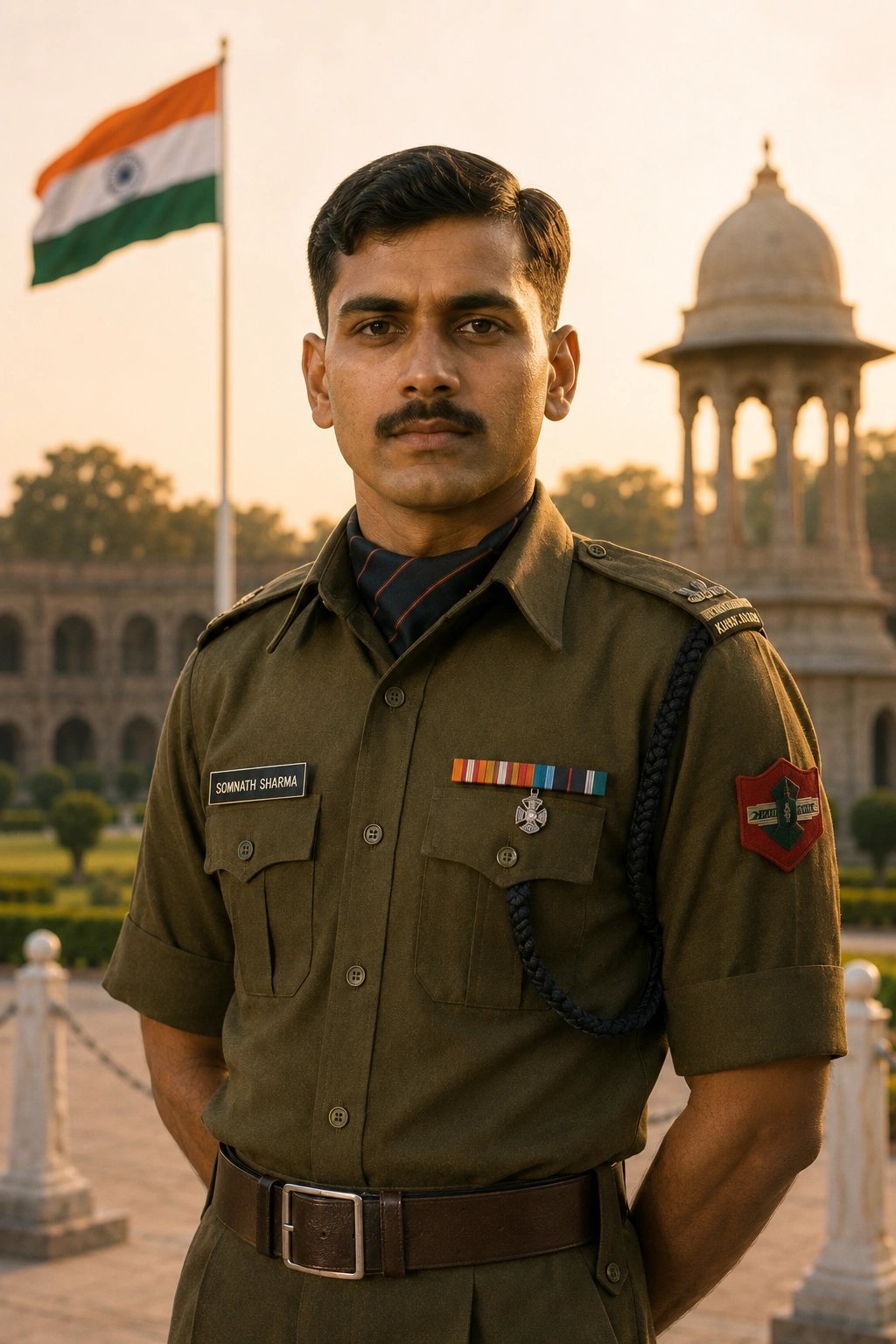
In a land where courage meets sacrifice, Major Somnath Sharma stands tall as a beacon of bravery, whose legacy continues to inspire countless souls in India. His heroism during the battle of Jammu and Kashmir is a story etched in the annals of history.
Introduction
Major Somnath Sharma was a distinguished officer of the Indian Army, renowned for his valor and sacrifice during the Indo-Pakistani War of 1947. He is celebrated as one of India’s greatest war heroes, whose unwavering commitment to duty and supreme courage on the battlefield made him a symbol of patriotism. His legacy is not only remembered in military circles but also deeply embedded in the hearts of ordinary Indians who cherish the spirit of sacrifice and bravery.
Quick Summary
- Full Name: Major Somnath Sharma
- Born: January 31, 1923, in Dhamtari, Chhattisgarh, India
- Profession: Indian Army Officer
- Known As: War Hero
- Career Span: 1942 – 1947
- Key Contributions:
- Bravery in the Battle of Badgam
- First recipient of the Ashoka Chakra, India’s highest peacetime military decoration
- Led his troops with exceptional leadership under fire
- Participated in the Indo-Pakistani War of 1947
- Inspired a generation of soldiers with his commitment to duty
- Remembered as a symbol of sacrifice and valor
- Quote: “The nation is greater than the individual.”
Early Life & Background
Major Somnath Sharma was born into a family with a rich military tradition. His father, a prominent army officer, instilled the values of discipline and courage in young Somnath from an early age. Growing up in Dhamtari, he was surrounded by stories of bravery and valor, which ignited a passion for serving his country. Somnath was an adventurous and spirited child, often found playing outdoors and exploring nature.
His early education took place in various schools, where he was known for his keen intelligence and leadership qualities. He showed great interest in sports, often participating in various competitions that nurtured his competitive spirit. It was during these formative years that he first discovered his desire to join the army, inspired by his father’s tales of bravery and honor.
As a teenager, he moved to Delhi for his higher education, where he attended St. Stephen’s College. Here, he continued to excel academically while also engaging in various extracurricular activities that honed his leadership skills. His experiences during this time solidified his resolve to serve in the Indian Army, where he could truly make a difference.
How It All Started
Somnath Sharma’s journey towards becoming a war hero began when he joined the Indian Military Academy (IMA) in Dehradun. It was a significant moment for him, as he was stepping into an environment filled with ambition, discipline, and camaraderie. At the IMA, he was surrounded by like-minded individuals who shared his dream of serving the nation. The rigorous training instilled a sense of resilience and determination in him.
During his time at the academy, Somnath was deeply inspired by the stories of past heroes, especially those who fought for India’s independence. This fueled his desire to be among those who would protect the nation. He embraced the arduous training, understanding that every challenge was a step towards fulfilling his dream. He often recalled the words of his instructors, emphasizing the importance of honor and sacrifice in the military profession.
After successfully completing his training, Somnath was commissioned as a Second Lieutenant in the 4th Battalion of the Kumaon Regiment in 1942. His early days in the army were filled with excitement as he was eager to prove himself. He participated in various exercises and drills, where he demonstrated exceptional skills as a leader. His commitment to his duties soon earned him respect among his peers and superiors.
However, his path was not without challenges. Being a young officer in a newly independent country, he faced difficulties related to resources and training. There were moments of doubt, especially during the initial confrontations with hostility from neighboring regions. Yet, Somnath remained steadfast, often recalling the teachings of his father and the sacrifice of those who came before him.
The turning point in his career came during the Indo-Pakistani War of 1947. As tensions escalated in Jammu and Kashmir, Somnath was deployed to the region. This was a defining moment that would test his mettle. He led his men into the battle of Badgam with unwavering resolve. Even in the face of overwhelming odds, he inspired those around him by exemplifying courage and strategic acumen.
During a fierce encounter, his battalion faced severe enemy fire. Despite being heavily outnumbered, Somnath refused to retreat. He motivated his troops by standing at the forefront, demonstrating determination and bravery. It was this moment that showcased his leadership, as he rallied his men and led them to hold their position against all odds. His actions during this battle not only earned him the admiration of his fellow soldiers but also marked his name in history as a true hero.
Somnath Sharma’s bravery did not go unnoticed. He was posthumously awarded the Ashoka Chakra for his outstanding courage, making him the first recipient of this prestigious honor. His legacy lives on, inspiring future generations to serve their country with honor and integrity.
Career Journey
Early Career
Major Somnath Sharma’s military journey began when he joined the Indian Army in 1942. He was commissioned into the 4 Kumaon Regiment, a unit with a proud history of valor and bravery. During his early days, Sharma trained rigorously, learning the fundamentals of infantry warfare. He quickly developed a reputation for his leadership skills and tactical acumen, which set the stage for his future endeavors. His early assignments took him to various military posts, allowing him to gain valuable experience in challenging terrains and operations.
One notable incident during this phase occurred in 1944, when Major Sharma participated in operations against the Japanese forces in the jungles of Eastern India. These experiences not only honed his skills but also instilled in him a sense of commitment and duty towards his country. The difficult conditions he faced during these operations laid the foundation for the bravery he would later display in the battle of Jammu and Kashmir.
Breakthrough Phase
The real turning point in Major Somnath Sharma’s career came in October 1947 when the Indo-Pakistani War broke out. As tensions escalated in the Jammu and Kashmir region, Major Sharma and his unit were deployed to the frontline. The situation was dire, with the Pakistani forces making significant advances into the region. Sharma’s unit was tasked with defending the strategic position at Srinagar, particularly the airfield that was crucial for air support and supply routes.
Major Sharma’s leadership was put to the test when his battalion was ordered to repel the advancing enemy. On November 3, 1947, during a fierce attack near Badgam, Major Sharma displayed extraordinary courage. Despite being outnumbered, he led his soldiers into battle, showcasing tactical brilliance and fearlessness. He was actively involved in repelling multiple assaults, inspiring his men to stand firm against the enemy. His ability to maintain composure under fire and form effective counter-strategies turned the tide for his battalion, marking a critical moment in the conflict.
Peak Career
Major Somnath Sharma’s peak came during the battle of Badgam on November 3, where he and his men faced overwhelming odds. With the enemy launching a major offensive, the situation quickly became precarious. Despite heavy artillery fire and casualties among his men, Sharma refused to retreat. He communicated effectively with his troops, organizing them to hold their positions and counterattack when necessary.
In an act of remarkable bravery, Major Sharma moved from one sector to another, encouraging his soldiers and providing tactical advice. His charisma and resolve instilled a sense of purpose among the troops. Unfortunately, as the battle raged on, he suffered grievous injuries. Sharma continued to fight valiantly, leading from the front until he fell to enemy fire. His last moments were spent ensuring that his men were rallying and that they understood the significance of holding their ground.
The battle of Badgam was not only a testament to Major Sharma’s military prowess but also a defining moment in Indian military history. His actions that day led to a significant delay in the enemy’s advance, ultimately saving Srinagar from capture. For his extraordinary bravery, he was posthumously awarded the Param Vir Chakra, India’s highest military honor. His legacy became a source of inspiration for generations of soldiers in the Indian Army.
Later Career
Although Major Somnath Sharma did not have a chance to continue his military career posthumously, his impact can be felt in the Indian Army to this day. His exemplary leadership and selfless sacrifice have been commemorated, and he is often cited as an ideal soldier and leader. In the years following his death, numerous memorials and institutions have been named in his honor, ensuring that his legacy is preserved.
Every year, the Indian Army remembers Major Sharma and his contributions during the Indo-Pakistani War of 1947. His story is taught in military academies, emphasizing the values of courage, commitment, and sacrifice. Furthermore, his gallant actions have inspired countless young officers to embody the same spirit of bravery and dedication in their service to the nation.
Major Achievements
- Posthumously awarded the Param Vir Chakra, India’s highest military honor, for exceptional bravery during the Indo-Pakistani War of 1947.
- Notable for his leadership during the Battle of Badgam, where he played a crucial role in defending against the Pakistani forces.
- Remembered as a pioneer of modern Indian military strategy due to his tactical insights during combat.
- His legacy continues to inspire generations of soldiers within the Indian Armed Forces.
- Several memorials and institutions have been established in his name, such as the Somnath Sharma Memorial in Delhi.
What Makes Them Special
Major Somnath Sharma is special not just for his bravery but also for his strategic thinking and leadership skills. He possessed an innate ability to inspire his men, fostering camaraderie and morale even in the direst of situations. His calm demeanor under pressure was a testament to his strong character and resolve. Sharma’s tactical approach to warfare emphasized adaptability and quick decision-making, which proved crucial during intense confrontations.
Moreover, his willingness to lead from the front, putting himself in harm’s way to protect his soldiers, embodies the highest ideals of military leadership. His dedication to duty and his unwavering commitment to his country make him an enduring symbol of heroism and patriotism in India.
Challenges & Struggles
Like many great leaders, Major Somnath Sharma faced significant challenges throughout his military career. The most pressing struggles arose during the chaotic early days of the Indo-Pakistani War, where the Indian forces were not fully prepared for the scale of conflict. The pressure to defend the newly formed nation was immense, with the stakes higher than ever.
Despite these challenges, Sharma remained resolute. He was faced with the loss of fellow soldiers and the constant threat of enemy advances. These trials honed his character and molded him into the leader he became. His ability to overcome adversity, even when the odds were stacked against him, is a testament to his strength and determination.
Though he did not survive to see the result of his sacrifices, Major Somnath Sharma’s legacy continues to resonate within the fabric of Indian military history, inspiring future generations to uphold the values for which he stood.
Legacy & Impact
Major Somnath Sharma is remembered as a symbol of courage and sacrifice in India. His bravery during the Indo-Pakistani War of 1947, especially in the battle of Jammu and Kashmir, inspired countless soldiers and future leaders. He played a significant role in defending India’s territory, which helped shape the nation’s military strategies. Major Sharma’s leadership and dedication continue to motivate young officers in the Indian Army. His legacy lives on through various memorials and honors dedicated to his memory, ensuring that future generations recognize his contributions.
Personal Life
Major Somnath Sharma was born into a military family, which influenced his early life choices. He married in 1946 and had a daughter. His love for the army was evident, and he often spent time with his family sharing stories of his experiences. Sharma was known for his disciplined lifestyle and deep commitment to his duties.
Interesting Facts
- Major Somnath Sharma was posthumously awarded the Param Vir Chakra, India’s highest military honor.
- He was a part of the famed 4 Kumaon Regiment, celebrated for its valor.
- Sharma was known for his exceptional leadership even at a young age.
- He played a key role in several crucial operations during the 1947 war.
- The Indian Army celebrates his bravery every year on Brigade Day.
- His family has continued to uphold his legacy, with many relatives serving in the armed forces.
- Major Sharma’s dedication to duty has made him an example for many in military training programs.
Frequently Asked Questions
Who is Major Somnath Sharma?
Major Somnath Sharma was an Indian Army officer known for his bravery during the Indo-Pakistani War of 1947.
Why is Major Somnath Sharma famous?
He is famous for his outstanding leadership and sacrifice during the battle of Jammu and Kashmir, where he lost his life while defending his country.
What are his achievements?
Major Sharma was posthumously awarded the Param Vir Chakra for his valor and exceptional leadership in combat.
What is his background?
He came from a military family and joined the Indian Army in 1942, eventually serving in the 4 Kumaon Regiment.
How did he influence future generations?
His courage and dedication serve as an inspiration for young officers and soldiers in the Indian Armed Forces.
What memorials honor his legacy?
Numerous memorials and honors, including streets and institutions, are named after him to commemorate his contributions.
Conclusion
Major Somnath Sharma’s life story is one of valor and dedication to his country. From his early career in the Indian Army to his heroic actions during the Indo-Pakistani War, his journey reflects the spirit of sacrifice. He remains a beacon of courage, inspiring future generations in the Indian Armed Forces. His legacy continues to thrive, reminding all of us of the importance of bravery and commitment to one’s nation.