
1
Major contributions to number theory
Major contributions to number theory forms part of Srinivasa Ramanujan’s wider contribution to Indian science, technology or public life.
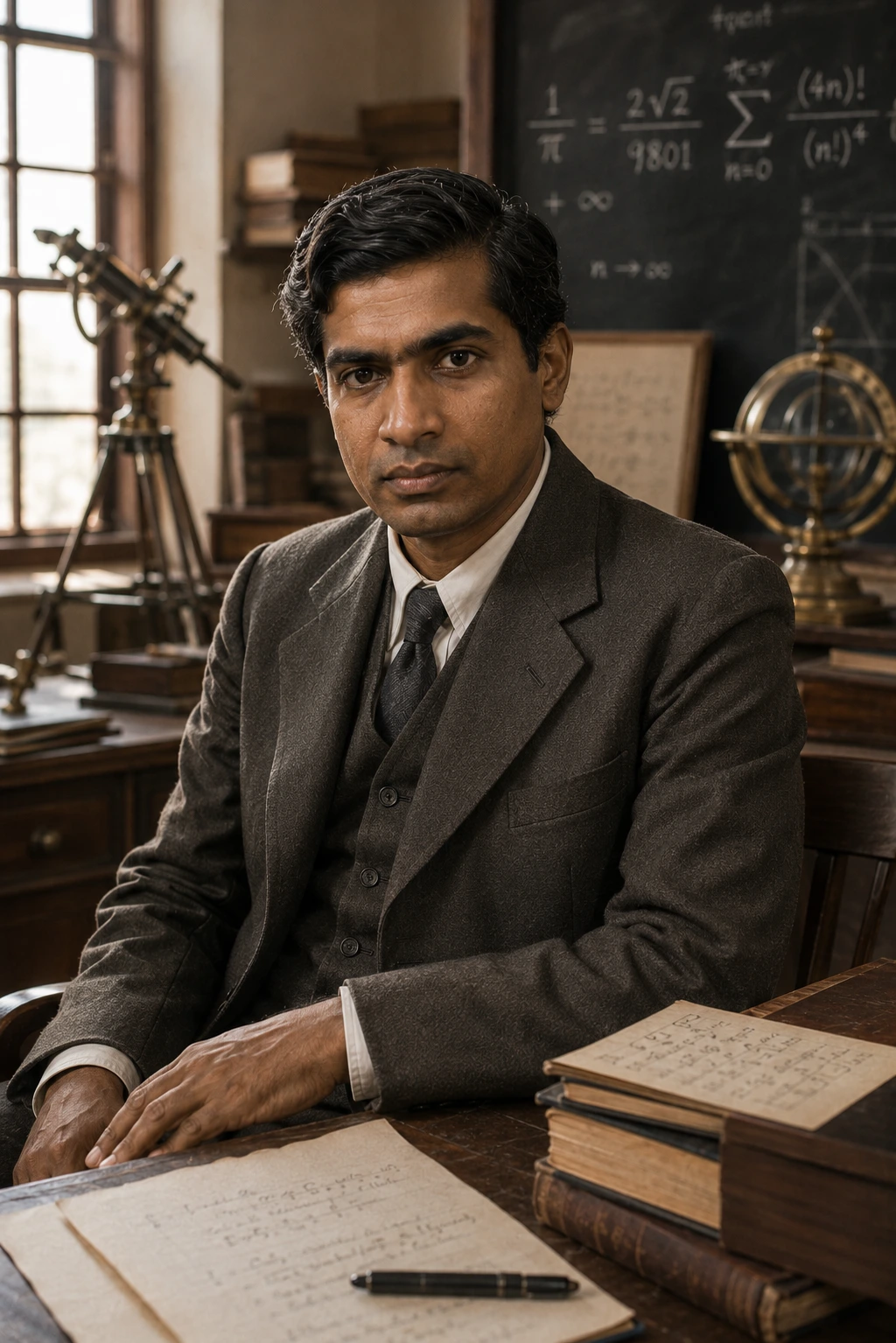
Working largely from intuition and sparse formal training, Ramanujan produced thousands of identities, series and number-theory results that continue to inspire mathematicians more than a century later.
In the quiet corners of 20th century India, a boy named Srinivasa Ramanujan transformed the world of mathematics with nothing but his brilliant mind and unyielding spirit. His journey from a small town to global acclaim is a tale of perseverance and genius.
Srinivasa Ramanujan was an Indian mathematician whose extraordinary contributions to the field have left a lasting impact on mathematics. He is celebrated for his groundbreaking work in number theory, continued fractions, and infinite series. His unique approach and intuitive understanding of numbers have inspired countless mathematicians around the world. Ramanujan's story is not just about numbers; it's about the power of passion and belief in one's abilities against all odds.
Srinivasa Ramanujan was born into a modest Brahmin family in Erode, a small town in southern India. His father, K. Srinivasa Iyengar, was a clerk, and his mother, Komalatammal, was a homemaker. The family lived in a humble household where education was valued, but finances were often tight. Ramanujan was a curious child who showed signs of brilliance from a young age. Even as a small boy, he was fascinated by numbers and often spent hours exploring mathematical concepts.
Ramanujan was born in Tamil Nadu and grew up in Kumbakonam, where mathematics quickly became his central passion.
A mathematical reference book exposed him to thousands of results and encouraged his highly independent style.
He filled notebooks with identities, series, continued fractions and number-theory results, often without conventional proofs.
Ramanujan sent examples of his work to Cambridge mathematician G. H. Hardy, who recognised his extraordinary originality.
He travelled to England and collaborated with Hardy during a remarkably productive period.
Ramanujan became one of the youngest Fellows and one of the first Indians elected to the Royal Society.
He returned to India in poor health and died young, leaving behind notebooks that researchers still study.
Ramanujan often wrote down results with little explanation, yet many later proved to be profound. Decades after his death, mathematicians continued finding new theorems and connections in his notebooks, including the celebrated ‘mock theta functions.’
Science • Innovation • IndiaMajor contributions to number theory forms part of Srinivasa Ramanujan’s wider contribution to Indian science, technology or public life.
Ramanujan prime and theta functions forms part of Srinivasa Ramanujan’s wider contribution to Indian science, technology or public life.
Famous work on partitions forms part of Srinivasa Ramanujan’s wider contribution to Indian science, technology or public life.
Fellow of the Royal Society forms part of Srinivasa Ramanujan’s wider contribution to Indian science, technology or public life.
Trinity College fellowship forms part of Srinivasa Ramanujan’s wider contribution to Indian science, technology or public life.
National Mathematics Day marks his birthday forms part of Srinivasa Ramanujan’s wider contribution to Indian science, technology or public life.
Ramanujan often wrote down results with little explanation, yet many later proved to be profound. Decades after his death, mathematicians continued finding new theorems and connections in his notebooks, including the celebrated ‘mock theta functions.’
Ramanujan’s influence reaches modern number theory, modular forms, combinatorics, mathematical physics and computer science. His life has also become a global symbol of raw mathematical creativity emerging outside conventional academic pathways.
Historical fellowship record and scientific context.
View source →Ramanujan’s Cambridge connection and mathematical history.
View source →Detailed mathematical biography.
View source →National Mathematics Day context.
View source →Working largely from intuition and sparse formal training, Ramanujan produced thousands of identities, series and number-theory results that continue to inspire mathematicians more than a century later.
Major contributions to number theory, Ramanujan prime and theta functions, Famous work on partitions.
Ramanujan’s influence reaches modern number theory, modular forms, combinatorics, mathematical physics and computer science. His life has also become a global symbol of raw mathematical creativity emerging outside conventional academic pathways.
Cambridge, Fellow of the Royal Society, Death at 32.
Help us improve the archive by suggesting reliable information or another Indian personality worth documenting.