
1
Founder of Bose–Einstein statistics
Founder of Bose–Einstein statistics forms part of Satyendra Nath Bose’s wider contribution to Indian science, technology or public life.
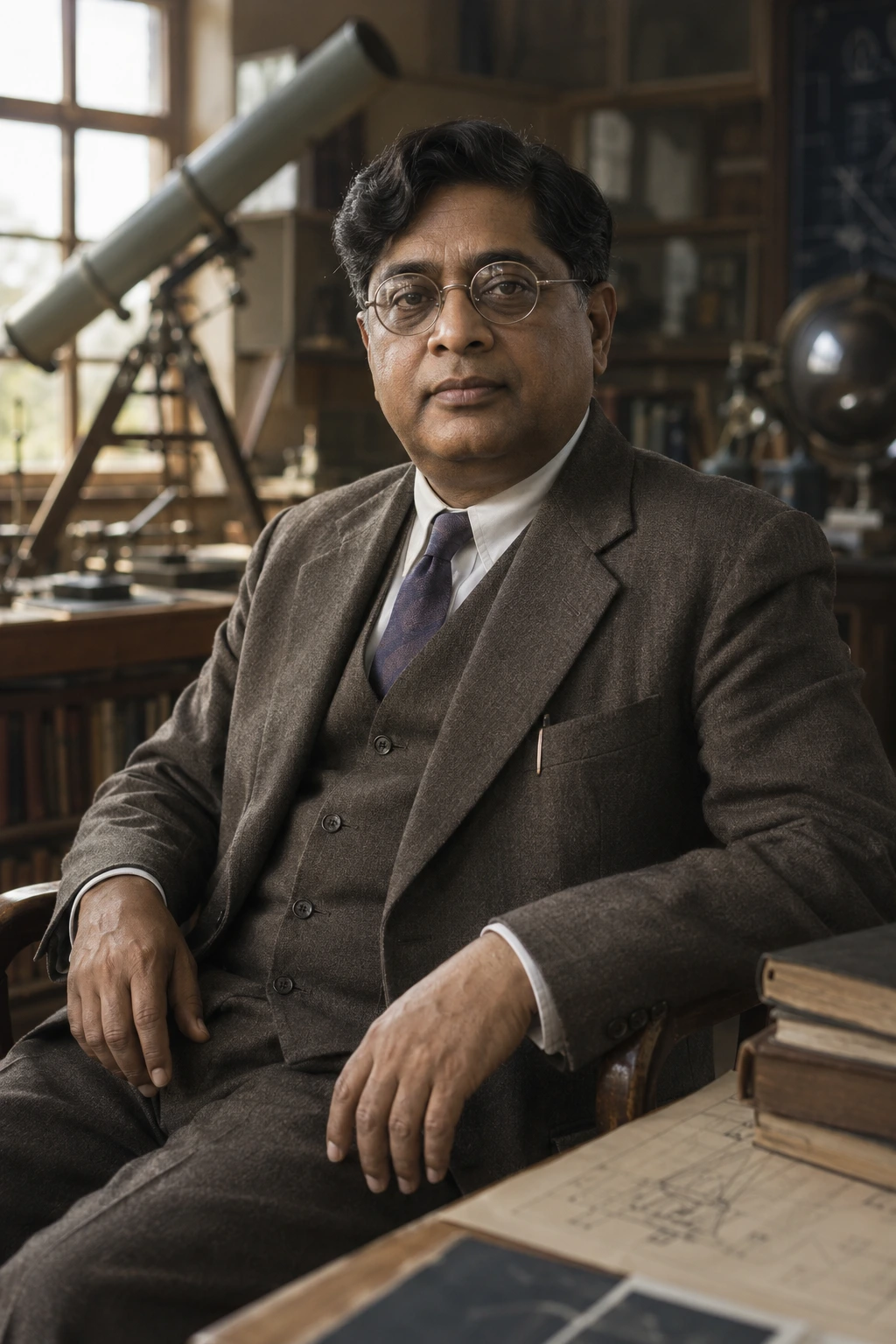
Bose’s statistical treatment of light particles opened a new path in quantum physics, eventually giving his name to an entire class of particles and to Bose–Einstein statistics.
In a world where the laws of physics seemed fixed, one man's groundbreaking ideas reshaped our understanding of the universe. Satyendra Nath Bose not only challenged the norms but also carved a legacy that continues to inspire scientists today.
Satyendra Nath Bose was an Indian physicist whose work transformed the field of quantum mechanics. He is best known for his collaboration with Albert Einstein, leading to the development of Bose-Einstein statistics and the prediction of a new state of matter, known today as Bose-Einstein condensate. His contributions have laid the foundation for modern physics and have been crucial in fields like condensed matter physics and quantum computing.
Satyendra Nath Bose was born in Kolkata, India, into a Bengali family that valued education and culture. His father, a lawyer, and his mother, a homemaker, encouraged a love for learning from a young age. The environment in their home was filled with books and discussions about science, literature, and philosophy. This rich cultural backdrop played a significant role in shaping his intellectual curiosity.
Bose grew up in an intellectually curious family and showed exceptional ability in mathematics from an early age.
He studied at Presidency College and later taught physics in Calcutta and Dhaka.
Bose derived Planck’s radiation law using a new counting method for light quanta.
After journals rejected the paper, Bose sent it directly to Albert Einstein, who translated and published it.
Einstein extended the method to material particles, establishing a major branch of quantum statistics.
Bose continued work across physics, chemistry, mineralogy and education in India.
Bose’s 1924 paper treated photons as indistinguishable particles in a novel statistical way. Einstein immediately recognised its importance, translated it into German and extended the idea—work that became foundational to quantum statistics.
Science • Innovation • IndiaFounder of Bose–Einstein statistics forms part of Satyendra Nath Bose’s wider contribution to Indian science, technology or public life.
Namesake of the boson particle class forms part of Satyendra Nath Bose’s wider contribution to Indian science, technology or public life.
Direct collaboration with Albert Einstein forms part of Satyendra Nath Bose’s wider contribution to Indian science, technology or public life.
Major contribution to quantum theory forms part of Satyendra Nath Bose’s wider contribution to Indian science, technology or public life.
Influential teacher and scientist in India forms part of Satyendra Nath Bose’s wider contribution to Indian science, technology or public life.
Padma Vibhushan recipient forms part of Satyendra Nath Bose’s wider contribution to Indian science, technology or public life.
Bose’s 1924 paper treated photons as indistinguishable particles in a novel statistical way. Einstein immediately recognised its importance, translated it into German and extended the idea—work that became foundational to quantum statistics.
His name lives permanently in modern physics: bosons include photons, gluons and the Higgs boson. Bose’s story also shows how a theoretical idea developed in India entered the deepest structure of twentieth-century physics.
Biographical reference on S. N. Bose.
View source →Modern physics context for bosons and the Higgs boson.
View source →History of Indian science.
View source →Government of India civilian honours records.
View source →Bose’s statistical treatment of light particles opened a new path in quantum physics, eventually giving his name to an entire class of particles and to Bose–Einstein statistics.
Founder of Bose–Einstein statistics, Namesake of the boson particle class, Direct collaboration with Albert Einstein.
His name lives permanently in modern physics: bosons include photons, gluons and the Higgs boson. Bose’s story also shows how a theoretical idea developed in India entered the deepest structure of twentieth-century physics.
Einstein recognises the work, Bose–Einstein statistics, Teaching and institution building.
Help us improve the archive by suggesting reliable information or another Indian personality worth documenting.