
1
Formulated the Saha ionization equation
Formulated the Saha ionization equation forms part of Meghnad Saha’s wider contribution to Indian science, technology or public life.
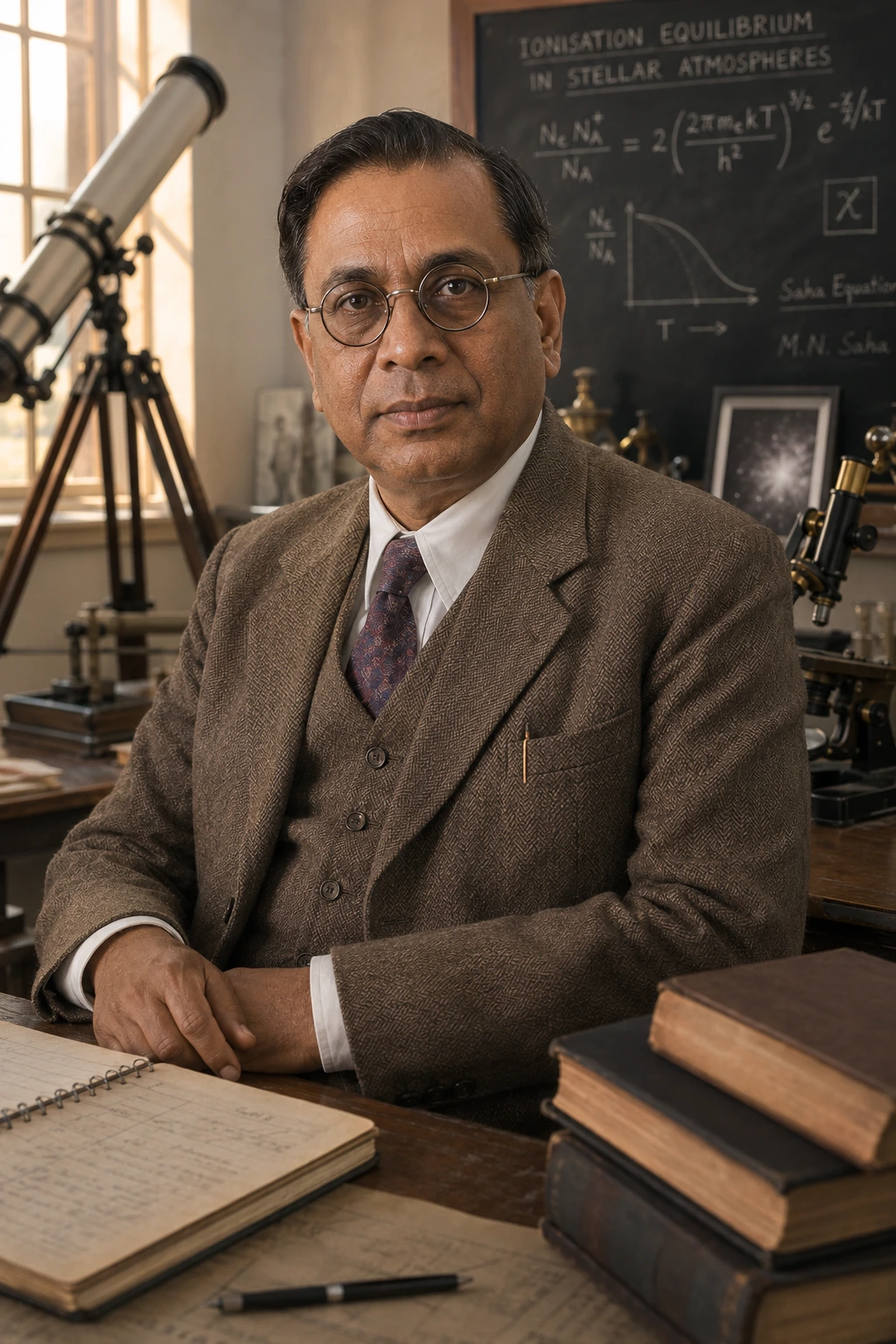
By connecting temperature, pressure and ionization in stars, Saha gave astronomers a powerful way to understand what stellar light reveals about the physical conditions of the universe.
Meghnad Saha's vision transformed the world of astrophysics, propelling India into a new era of scientific exploration. His legacy shines brightly, inspiring countless minds to look beyond the stars.
Meghnad Saha was an Indian astrophysicist, best known for his groundbreaking work in the field of thermal ionization. His contributions to science have not only enriched the understanding of stellar atmospheres but also paved the way for India’s progress in space research. Saha's work remains essential in connecting physics and chemistry within the cosmos, making him a towering figure in the scientific community.
Meghnad Saha was born into a modest Bengali family in a small village. His father was a school teacher who instilled the values of education and curiosity in him from a young age. Growing up in the late 19th century, Saha was surrounded by the rich culture and intellectual fervor of Bengal, which significantly influenced his early development.
Born in a modest family in what is now Bangladesh, Saha pursued education despite significant financial constraints.
He studied at Presidency College and the University College of Science in Calcutta alongside future leading scientists.
Saha published work linking thermal ionization to stellar spectra, creating one of astrophysics’ most useful analytical tools.
His research gained global attention and influenced observational astrophysics.
He helped strengthen scientific education and research institutions in India.
Saha entered public life and advocated strongly for national planning, river management and scientific infrastructure.
Saha’s ionization equation made it possible to relate the spectral lines seen in stars to their temperature and ionization conditions. This helped turn spectroscopy from description into a more quantitative tool for understanding stellar atmospheres.
Science • Innovation • IndiaFormulated the Saha ionization equation forms part of Meghnad Saha’s wider contribution to Indian science, technology or public life.
Major contribution to astrophysics and stellar spectroscopy forms part of Meghnad Saha’s wider contribution to Indian science, technology or public life.
Built scientific institutions in India forms part of Meghnad Saha’s wider contribution to Indian science, technology or public life.
Advocated national science planning forms part of Meghnad Saha’s wider contribution to Indian science, technology or public life.
Elected Fellow of the Royal Society forms part of Meghnad Saha’s wider contribution to Indian science, technology or public life.
Combined research with public policy forms part of Meghnad Saha’s wider contribution to Indian science, technology or public life.
Saha’s ionization equation made it possible to relate the spectral lines seen in stars to their temperature and ionization conditions. This helped turn spectroscopy from description into a more quantitative tool for understanding stellar atmospheres.
His legacy spans both science and nation-building. Saha demonstrated how theoretical physics could solve real astronomical problems while also arguing that scientific thinking should shape public infrastructure and planning.
Biographical reference on Meghnad Saha.
View source →Historical fellowship and scientific records.
View source →History of Indian science and scientists.
View source →Institution named in his honour.
View source →By connecting temperature, pressure and ionization in stars, Saha gave astronomers a powerful way to understand what stellar light reveals about the physical conditions of the universe.
Formulated the Saha ionization equation, Major contribution to astrophysics and stellar spectroscopy, Built scientific institutions in India.
His legacy spans both science and nation-building. Saha demonstrated how theoretical physics could solve real astronomical problems while also arguing that scientific thinking should shape public infrastructure and planning.
International recognition, Institution builder, Science and public policy.
Help us improve the archive by suggesting reliable information or another Indian personality worth documenting.