

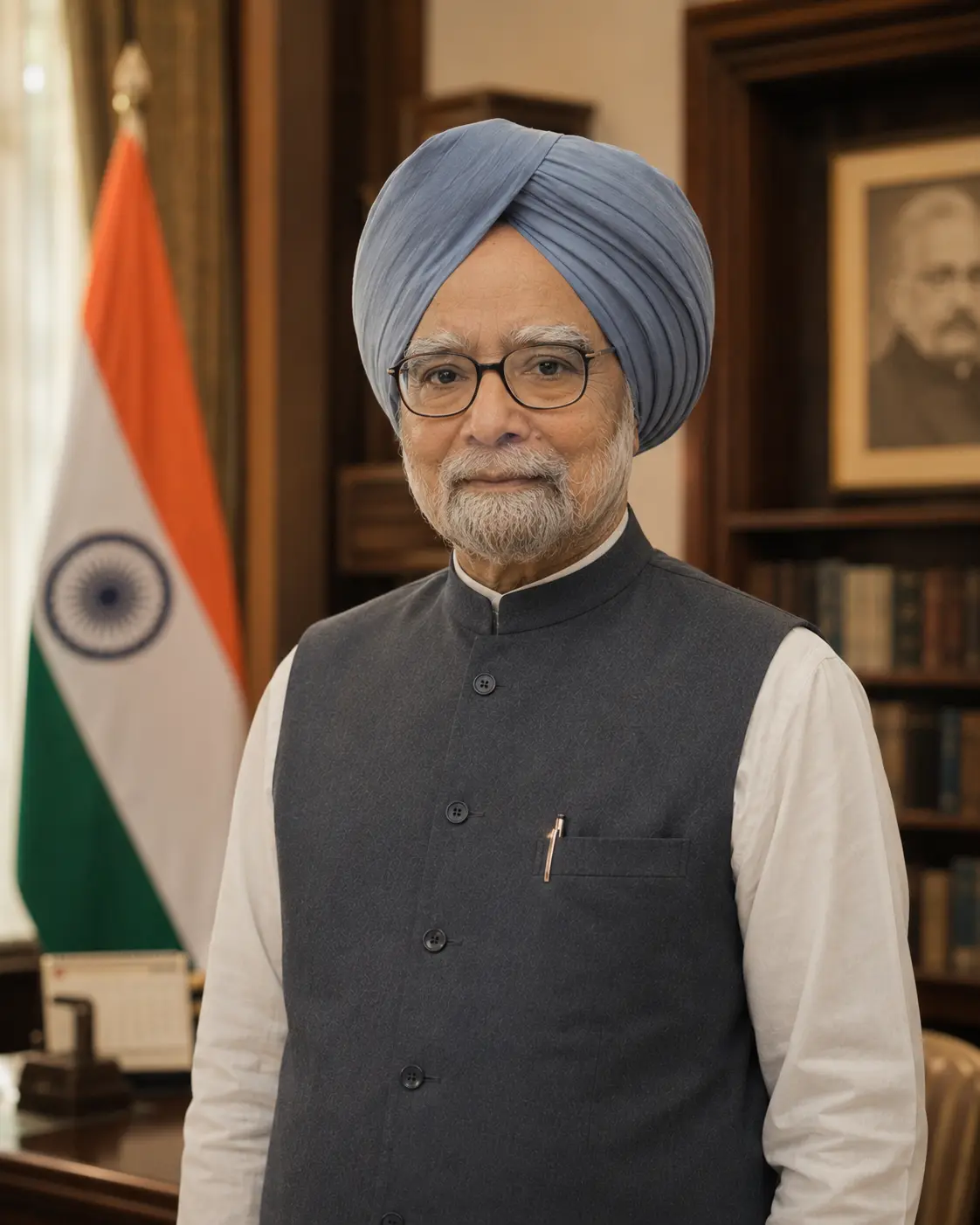
In the world of Indian politics, few figures resonate as deeply as Dr. Manmohan Singh. His calm demeanor and steady leadership during challenging times have left an indelible mark on the nation. Singh’s journey from a humble background to becoming Prime Minister is a tale of resilience and dedication.
Introduction
Dr. Manmohan Singh is a distinguished Indian economist and politician who served as the Prime Minister of India from 2004 to 2014. He is known for his pivotal role in shaping India’s economic policies and steering the nation through a period of significant growth. His pragmatic approach and commitment to reform have made him a respected figure both in India and internationally.
Quick Summary
- Full Name: Dr. Manmohan Singh
- Born: September 26, 1932, Gah, Punjab (now in Pakistan)
- Profession: Economist, Politician
- Known As: Former Prime Minister of India
- Career Span: 1956 – Present
- Key Contributions:
- Pioneered economic reforms in India in the 1990s
- Served as the Finance Minister during a crucial economic transition
- Led India during a period of robust economic growth
- Promoted policies for poverty alleviation and inclusive growth
- Strengthened India’s position on the global stage
- Advocated for sustainable development
- Quote: “The power to question is the basis of all human progress.”
Early Life & Background
Dr. Manmohan Singh was born into a Sikh family in the small village of Gah, which was then part of Punjab. His father, Gurmukh Singh, was a general in the army, and his mother, Amrit Kaur, was a homemaker. The family faced hardships during the partition of India in 1947 when they had to flee to India, leaving behind their ancestral home. This experience of displacement had a profound impact on Singh, shaping his views on social justice and economic equality.
Growing up in a modest environment, Singh developed a strong affinity for education. He was an eager learner and spent much of his childhood engrossed in books. His early education took place in local schools, where he showed exceptional academic talent, especially in subjects like mathematics and economics. Singh’s teachers recognized his potential and encouraged him to pursue higher studies.
After completing high school, he moved to Delhi to attend Panjab University, where he earned a Bachelor’s degree in Economics. His early life was marked by a deep commitment to learning, undoubtedly influenced by the struggles his family faced. This commitment laid the foundation for his later pursuits in economics and public policy.
How It All Started
Dr. Manmohan Singh’s path to becoming a prominent figure in Indian politics began with his passion for economics. His interest was sparked during his undergraduate studies, where he was introduced to the complexities of economic systems and the importance of effective governance. Singh was particularly influenced by renowned economists and their theories on development and poverty alleviation. His professors played a pivotal role in shaping his understanding of economic policies and their impact on society.
After completing his education, Singh pursued a Master’s degree in Economics at the University of Cambridge and later obtained a D.Phil. from the University of Oxford. His time in the UK was transformative; he was exposed to diverse economic ideas and practices. He often reminisced about working late nights in the library, immersing himself in the works of great economists. This dedication to studying economic theory equipped him with the knowledge he would later apply in real-world scenarios.
Returning to India, Singh began his career at the Reserve Bank of India, where he focused on monetary policy and financial regulations. His analytical skills quickly gained the attention of senior officials, and he was promoted to key positions. However, it was during the late 1980s and early 1990s, a tumultuous time for India, that he truly made his mark. Singh was appointed as the Chief Economic Adviser to the Government of India, where he had the opportunity to influence economic policy directly.
The turning point in Singh’s career came during the economic crisis of 1991. Faced with a severe balance of payments crisis, the Indian government was on the brink of default. In this critical moment, Singh was entrusted with the role of Finance Minister. He introduced landmark reforms that liberalized the Indian economy, reducing trade barriers and encouraging foreign investment. This period was marked by long hours in the office, drafting policies that would revolutionize India’s economic landscape. His calm demeanor and analytical approach earned him respect among his peers and set the stage for his future as a leader.
Despite the initial resistance to change, Singh’s reforms began to bear fruit. The Indian economy started to stabilize, and growth resumed. His strategic vision and commitment to reform were recognized both domestically and internationally. Singh’s work during this period laid a strong foundation for his later role as Prime Minister, where he continued to champion economic development and social welfare.
Career Journey
Early Career
Dr. Manmohan Singh’s career began in the early 1960s after he completed his studies at Cambridge University and then at the London School of Economics. His early work was marked by positions in various government departments. He joined the Ministry of Finance in 1966 as an advisor. Here, he worked on economic planning and was involved in formulating policies aimed at improving India’s economy. His analytical skills and deep understanding of economics gained him recognition swiftly.
In 1971, Singh became the chief economic advisor in the Ministry of Finance. During this time, he played a crucial role in drafting the fifth Five-Year Plan, which focused on the strategy of self-reliance in the Indian economy. This period laid the groundwork for his future roles in economic policy-making and showed the importance of economics in governance. Singh’s work during these formative years was marked by a commitment to understanding India’s complex economic challenges.
Breakthrough Phase
Singh’s breakthrough came in the early 1990s, a time of economic crisis for India. As the country faced a balance of payments crisis in 1991, the then Prime Minister P. V. Narasimha Rao appointed him as the Finance Minister. Singh’s economic reforms during this turbulent time were nothing short of revolutionary. He introduced policies that opened up the Indian economy to international markets, reducing import tariffs and deregulating many sectors.
Singh’s 1991 budget is often cited as a significant turning point in Indian economic history. He presented a vision for liberalization that aimed to boost growth and attract foreign investment. This moment was critical as it shifted the direction of India’s economy from a closed, socialist model to a more market-oriented approach. His work led to increased foreign direct investment (FDI) and set the stage for India’s rapid economic growth in the years to come.
Peak Career
After serving as the Finance Minister, Singh’s reputation as a skilled economist and a pragmatic leader grew immensely. In 2004, he became the Prime Minister of India, leading the United Progressive Alliance (UPA). Singh’s tenure as Prime Minister was marked by several significant achievements. He focused on economic reforms that aimed to reduce poverty and enhance social welfare.
During his time in office, Singh faced many challenges, including domestic terrorism, rising inflation, and economic disparities. However, he managed to maintain a steady course, ensuring that India continued on its path of economic growth. One of the landmark moments of his leadership was the implementation of the National Rural Employment Guarantee Act in 2005, which aimed to provide at least 100 days of guaranteed wage employment in a financial year to every rural household.
Singh’s foreign policy also saw substantial development. He strengthened India’s relationships with other countries, particularly the United States. The Indo-US nuclear deal in 2008 was a significant milestone, opening up cooperation in various fields, including energy and defense. Singh’s leadership during this period, especially during the global financial crisis of 2008, showcased his ability to navigate the nation through adversity.
Later Career
Singh’s last term as Prime Minister ended in 2014, but his influence on Indian politics and economics continued. After leaving office, he remained an esteemed figure in academic and policy circles, often called upon to share his insights on economic growth and development. Despite stepping away from active politics, Singh’s ideas and policies are still discussed and evaluated in contemporary debates about India’s growth trajectory.
Throughout his career, Dr. Singh has been an advocate for inclusive growth, focusing on the upliftment of marginalized communities and ensuring that the benefits of economic growth reach every citizen. His modesty and dedication to public service have earned him respect across political lines, making him a unique figure in Indian politics.
Major Achievements
- Served as Prime Minister of India from 2004 to 2014.
- Instrumental in liberalizing India’s economy during the 1991 economic crisis.
- Implemented the National Rural Employment Guarantee Act in 2005.
- Established the Indo-US civil nuclear agreement in 2008.
- Awarded the Padma Vibhushan in 1987 for his contributions to Indian society.
- Recognized globally as a leading economist and served as the Governor of the Reserve Bank of India.
- Played a crucial role in fostering better relations with several countries, enhancing India’s global standing.
What Makes Them Special
Dr. Manmohan Singh is known for his exceptional analytical skills and deep understanding of economics. His calm demeanor allows him to handle pressure effectively, making him a steady presence during crises. Singh’s leadership style is characterized by consensus-building, often bringing various stakeholders together to find common ground on complex issues.
His dedication to inclusive growth and social justice sets him apart from many leaders. Singh is not only focused on economic numbers but also emphasizes the need for development that benefits all sections of society. His humility and integrity resonate with many, as he is often seen as a politician who prioritizes the nation’s interest over personal gain.
Challenges & Struggles
Despite his numerous successes, Singh faced significant challenges during his career. His tenure as Prime Minister was often clouded by criticisms over issues such as corruption within his government and economic slowdowns. The 2G spectrum scandal and the Commonwealth Games controversy during his second term raised questions about his administration’s ability to manage corruption effectively.
Additionally, Singh faced mounting opposition and criticism from political adversaries who accused him of being indecisive. The pressures of coalition politics often made it difficult for him to push through reforms. Nonetheless, Singh responded to these challenges with resilience, focusing on his policy agenda and maintaining a commitment to economic stability.
Throughout his career, Singh has displayed an unwavering commitment to his principles, often choosing to prioritize policy over popularity. His ability to remain calm and collected in the face of adversity is a testament to his character and dedication to the nation.
Legacy & Impact
Dr. Manmohan Singh is remembered as a pivotal figure in India’s economic transformation. His leadership during the 1991 economic crisis marked a turning point for the country. He introduced significant reforms that opened India’s economy to global markets, leading to rapid growth and modernization. Singh’s vision for a liberalized economy helped reduce poverty and improve living standards for millions of Indians.
His tenure as Prime Minister from 2004 to 2014 reinforced this legacy. Singh’s policies emphasized inclusive growth, education, and health, influencing not only policymakers but also future leaders in India and beyond. Many economists and political leaders cite him as a major influence in their own careers, shaping modern economic thought in India.
Personal Life
Dr. Manmohan Singh was born on September 26, 1932, in Gah, Punjab, now in Pakistan. He is married to Gursharan Kaur, and they have three daughters. Singh is known for his humble lifestyle and dedication to public service. In his spare time, he enjoys reading and is particularly fond of history and literature.
Interesting Facts
- Dr. Singh served as the Prime Minister of India for a decade, from 2004 to 2014.
- He holds a degree in Economics from Cambridge and a D.Phil from the London School of Economics.
- Singh was awarded the prestigious Jawaharlal Nehru Award for International Understanding in 2009.
- He has been a member of the Rajya Sabha, representing the state of Assam.
- Dr. Singh is known for his calm demeanor and is often referred to as a man of few words.
- He played a crucial role in establishing the National Rural Employment Guarantee Act, which aimed to provide employment to millions.
- His government focused on social welfare programs, including the Right to Information Act.
Frequently Asked Questions
Who is Dr. Manmohan Singh?
Dr. Manmohan Singh is an Indian economist and politician, known for his role as the Prime Minister of India from 2004 to 2014.
Why is Dr. Manmohan Singh famous?
He is famous for his economic reforms that transformed India into one of the fastest-growing economies in the world.
What are his achievements?
His major achievements include liberalizing the Indian economy, improving social welfare programs, and steering India through significant economic challenges.
What is his background?
Singh was born in Punjab and studied at prestigious institutions like Cambridge and the London School of Economics.
What role did he play in the 1991 economic crisis?
As Finance Minister, he implemented critical reforms that opened India’s economy and stabilized its financial situation.
Is he still active in politics?
Dr. Singh continues to be a respected figure in Indian politics, though he has stepped back from active political roles since 2014.
Conclusion
Dr. Manmohan Singh’s journey from a humble background to becoming a key architect of India’s economic policies is truly inspiring. His leadership not only reshaped India’s economy but also left a lasting impact on the lives of millions. As a respected elder statesman, he continues to inspire future generations of leaders and economists. His life story serves as a reminder of the power of dedication, intellect, and vision in creating change.