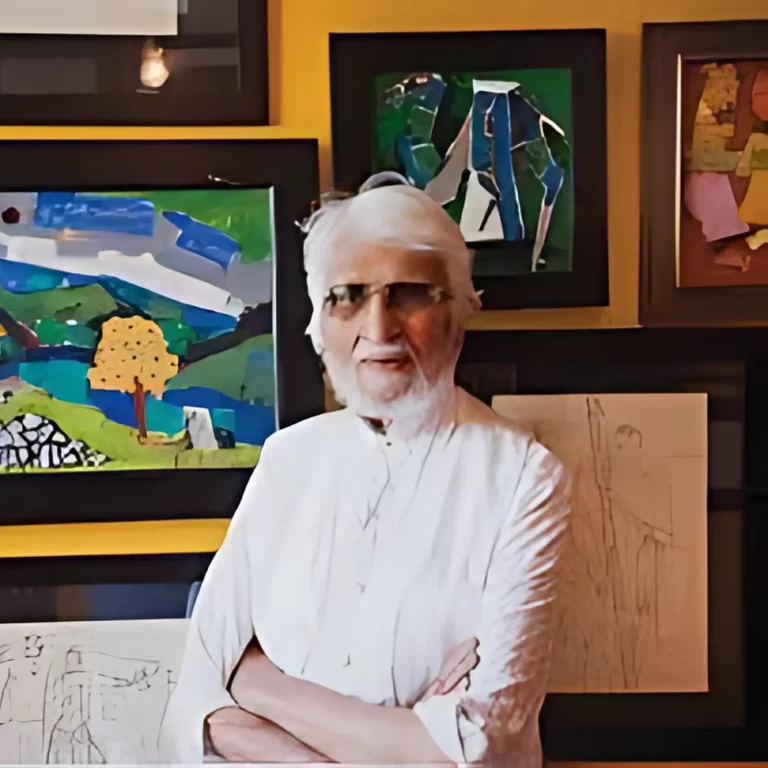
M. F. Husain Biography – The Picasso of India Who Painted Stories on Canvas

M. F. Husain revolutionized Indian art with his bold strokes and global impact.

Quick Summary

Full Name: Maqbool Fida Husain
Born: 17th September 1915, Pandharpur, Maharashtra, India
Died: 9th June 2011, London, UK
Profession: Painter, Artist, Filmmaker
Known As: “Picasso of India”
Career Span: 1940s – 2011
Key Contributions:

  • India’s most celebrated modern painter, known for bold, vibrant, and controversial art.

  • Co-founder of the Progressive Artists’ Group.

  • Created iconic works depicting Indian culture, mythology, and history.

  • Directed films like Through the Eyes of a Painter and Gaja Gamini.

  • Awarded Padma Shri, Padma Bhushan, and Padma Vibhushan.

Quote:
“I only paint when I am in love.” — M. F. Husain

Early Life & Childhood

Maqbool Fida Husain, popularly known as M. F. Husain, was born on 17 September 1915 in Pandharpur, Maharashtra. Coming from a modest background, Husain lost his mother at a very young age. This early tragedy deeply shaped his worldview, instilling in him both a sense of loss and a lifelong search for expression through art.

As a child, he showed keen interest in sketching and drawing, often using walls, floors, and scraps of paper as his canvas. With limited financial resources, Husain’s journey into art was entirely self-motivated. He taught himself by observing his surroundings, sketching people, animals, and landscapes with extraordinary detail.

At the age of 20, Husain moved to Indore and then Bombay (now Mumbai), where he joined the Sir J. J. School of Art, one of India’s most prestigious art institutions. His years in Bombay exposed him to new artistic movements, cinema, and cultural dynamism that would later define his style.

Journey into Art

Husain’s career began humbly as a billboard painter. He would paint large cinema hoardings across Mumbai to earn a living. The bold brushstrokes and exaggerated forms he developed for hoardings eventually became the signature style of his later paintings.

At the same time, he started creating his own canvases, focusing on Indian themes — gods, goddesses, mythology, women, horses, and village life. He was one of the earliest artists to blend modern techniques with traditional Indian narratives, creating works that were both deeply rooted in Indian culture and globally appealing.

Rise as “India’s Picasso”

By the late 1940s, Husain became associated with the Progressive Artists’ Group (PAG) in Bombay, alongside artists like F. N. Souza, S. H. Raza, and Tyeb Mehta. This group aimed to break free from colonial-era artistic restrictions and redefine Indian modern art.

Husain’s works quickly gained recognition for their bold lines, vibrant colors, and semi-abstract figures. His horses became iconic symbols — powerful, energetic, and timeless.

International critics compared him to Pablo Picasso, both for his prolific output and his daring creativity. The label “India’s Picasso” stuck, but Husain always maintained his unique artistic identity, rooted in Indian stories and traditions.

Famous Paintings & Themes

Some of Husain’s most iconic paintings include:

  • Mother Teresa Series – capturing compassion and sacrifice.
  • Horses Series – symbolizing strength, speed, and grace.
  • Mahabharata & Ramayana Series – reinterpreting Indian epics through modernist strokes.
  • Indian Women – celebrating femininity, motherhood, and strength.
  • British Raj & Partition Themes – exploring political and historical struggles.

His style was minimal yet powerful, with flowing lines that could convey deep emotions in a few strokes.

Controversies & Challenges

Despite his fame, Husain’s career was not without controversies. His paintings of Hindu deities in nude or abstract forms drew criticism and court cases from religious groups in the 1990s and 2000s.

He faced death threats, vandalism of exhibitions, and hundreds of lawsuits filed against him. These controversies forced Husain into self-imposed exile in 2006. He spent his later years in Qatar and London, never returning permanently to India.

While critics accused him of disrespect, many defenders argued his works were artistic expressions rather than deliberate provocations.

International Recognition

Husain’s work was celebrated across the globe. His exhibitions were held in major art capitals — London, New York, Paris, Doha, and Dubai.

He collaborated with international brands and filmmakers, including designing for the 1972 Munich Olympics and working with Madhuri Dixit and Tabu in films.

In 2010, the Qatar royal family even offered him citizenship, recognizing his immense cultural value.

Film & Creative Works

  • Beyond painting, Husain ventured into filmmaking. His most notable film, Through the Eyes of a Painter (1967), won the Golden Bear at the Berlin International Film Festival.

    He also directed feature films like Gaja Gamini (2000) starring Madhuri Dixit and Meenaxi: A Tale of Three Cities (2004). Though commercially controversial, these films showcased his experimental spirit.

Awards & Honors

Husain received numerous awards, including:

  • Padma Shri (1966)
  • Padma Bhushan (1973)
  • Padma Vibhushan (1991) – India’s second-highest civilian honor
  • International recognition at global art biennales and film festivals

Despite controversies, his contribution to modern Indian art remains unparalleled.

Later Years & Exile

From 2006 onwards, Husain lived mostly in Doha and London. Though he longed for his homeland, he never returned permanently due to ongoing legal threats.

In 2010, he accepted Qatari citizenship but expressed his Indian identity till the very end.

On 9 June 2011, Husain passed away in London at the age of 95. His death marked the end of an era in Indian art.

Legacy of M. F. Husain

F. Husain remains one of the most celebrated and controversial artists in Indian history. His ability to capture movement, mythology, and modernity in a single frame made him a pioneer.

Today, his works are displayed in museums, galleries, and private collections worldwide, often fetching millions at auctions.

For young artists, Husain’s life is a lesson in fearless creativity — to break boundaries, embrace boldness, and let art speak beyond borders.

Conclusion

The Satyajit Ray biography is not just the story of a filmmaker but of a visionary who transformed Indian cinema. From the rural lanes of Bengal to the world stage of Hollywood, Ray’s journey remains a symbol of passion, dedication, and creativity.

He was not just an Academy Award-winning filmmaker but also a writer, illustrator, and cultural ambassador of India. His films continue to move hearts, reminding us that cinema, at its best, is about humanity itself.

FAQ's

Because of his modernist approach, unique style, and influence on global art.

Padma Shri, Padma Bhushan, and Padma Vibhushan.