
1
Formulated the Chandrasekhar limit
Formulated the Chandrasekhar limit forms part of Subrahmanyan Chandrasekhar’s wider contribution to science, technology or public life.
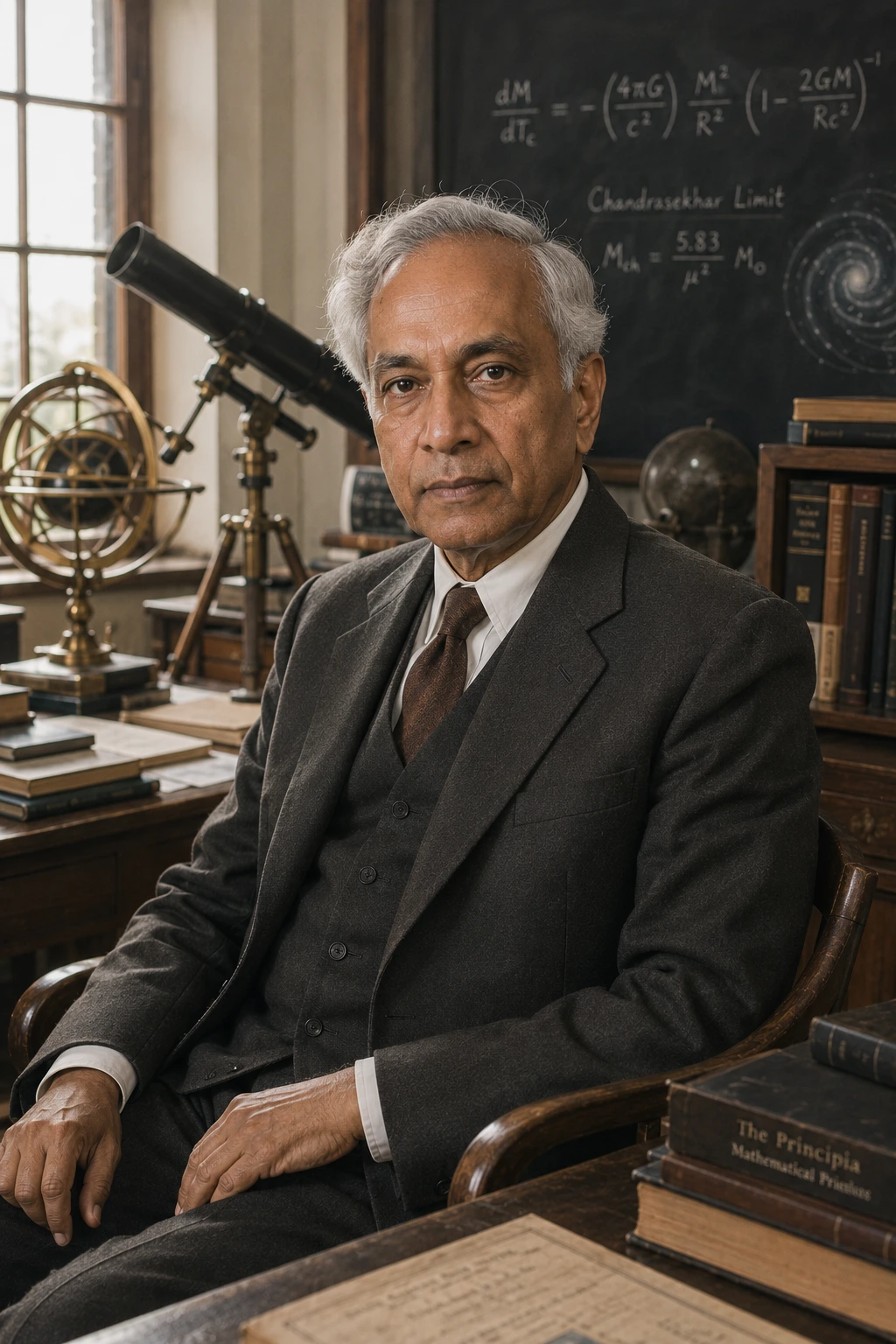
His work on stellar structure and the Chandrasekhar limit helped explain how white dwarfs, neutron stars and black holes emerge from stellar evolution.
Subrahmanyan Chandrasekhar's life is a powerful story of curiosity and discovery. He soared into the universe, exploring the secrets of stars, and his work changed how we understand the cosmos forever.
Subrahmanyan Chandrasekhar was a brilliant physicist known for his groundbreaking research in astrophysics. He made significant contributions to our understanding of stellar evolution and black holes. His work earned him the Nobel Prize in Physics in 1983, recognizing him as one of the most influential scientists of the 20th century. His legacy continues to inspire generations of scientists and students around the world.
Subrahmanyan Chandrasekhar was born into a family that valued education and knowledge. His father, a high school teacher, and his mother, a homemaker, encouraged his curiosity from a young age. Growing up in Lahore, he was surrounded by rich culture and history. Even as a child, Subrahmanyan showed a keen interest in science, often asking questions about the stars and the universe.
Born into a scholarly family, Chandrasekhar showed early strength in mathematics and physics.
On his journey to England, he began calculations on relativistic electron degeneracy in dense stars.
He showed that white dwarfs above a critical mass cannot remain stable, challenging prevailing ideas about stellar evolution.
He moved to the United States and built a long research career spanning stellar dynamics, radiative transfer and relativity.
His books and papers shaped multiple branches of astrophysics and mathematical physics.
He shared the Nobel Prize for theoretical studies of the physical processes important to stellar structure and evolution.
Chandrasekhar showed that electron degeneracy pressure can support a white dwarf only up to a critical mass of about 1.4 times the Sun’s mass. Beyond that, a star must undergo further collapse, opening the theoretical path toward neutron stars and black holes.
Science • Innovation • IndiaFormulated the Chandrasekhar limit forms part of Subrahmanyan Chandrasekhar’s wider contribution to science, technology or public life.
Nobel Prize in Physics, 1983 forms part of Subrahmanyan Chandrasekhar’s wider contribution to science, technology or public life.
Major contributions to stellar structure forms part of Subrahmanyan Chandrasekhar’s wider contribution to science, technology or public life.
Work on black holes and relativity forms part of Subrahmanyan Chandrasekhar’s wider contribution to science, technology or public life.
Long career at University of Chicago forms part of Subrahmanyan Chandrasekhar’s wider contribution to science, technology or public life.
Influential scientific monographs forms part of Subrahmanyan Chandrasekhar’s wider contribution to science, technology or public life.
Chandrasekhar showed that electron degeneracy pressure can support a white dwarf only up to a critical mass of about 1.4 times the Sun’s mass. Beyond that, a star must undergo further collapse, opening the theoretical path toward neutron stars and black holes.
His work is foundational to modern astrophysics. The Chandrasekhar limit is still a central concept in stellar evolution, supernova physics and cosmology.
Official Nobel biography and award record.
View source →Institutional history and Chandrasekhar’s academic career.
View source →Biographical reference.
View source →Stellar-evolution and white-dwarf context.
View source →His work on stellar structure and the Chandrasekhar limit helped explain how white dwarfs, neutron stars and black holes emerge from stellar evolution.
Formulated the Chandrasekhar limit, Nobel Prize in Physics, 1983, Major contributions to stellar structure.
His work is foundational to modern astrophysics. The Chandrasekhar limit is still a central concept in stellar evolution, supernova physics and cosmology.
University of Chicago, Broad theoretical work, Nobel Prize in Physics.
Help us improve the archive by suggesting reliable information or another Indian personality worth documenting.