

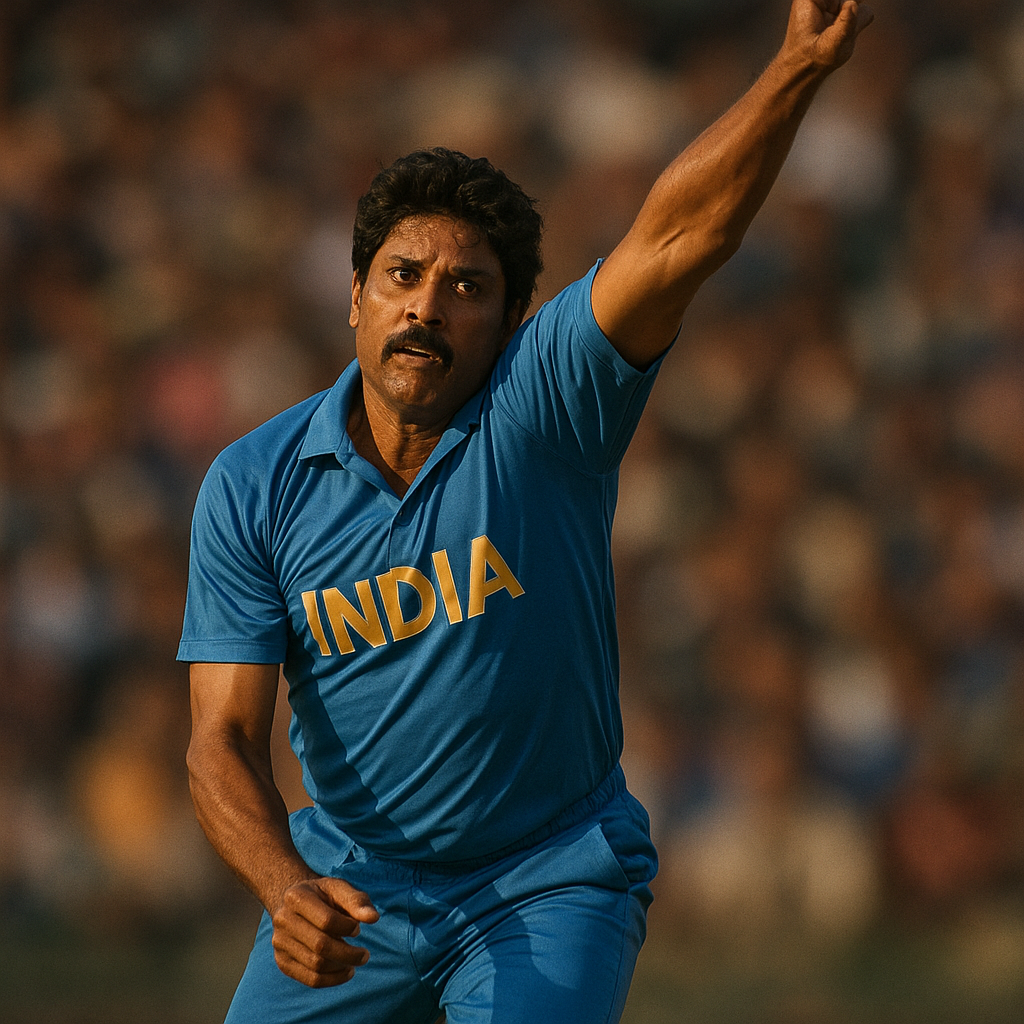
In the world of cricket, few names resonate as powerfully as Kapil Dev’s. With his towering presence and unwavering spirit, he led India to its first World Cup victory in 1983, changing the face of Indian cricket forever.
Introduction
Kapil Dev, a legendary Indian cricketer, is celebrated not just for his exceptional skills on the field but also for his role as a captain who inspired a generation. He is known for his incredible all-round abilities, being one of the finest fast bowlers and an explosive batsman. Kapil Dev’s contributions to the game have earned him a special place in cricket history, making him a true icon of Indian sports.
Quick Summary
- Full Name: Kapil Dev Ramlal Nikhanj
- Born: January 6, 1959, in Chandigarh, India
- Profession: Cricketer
- Known As: Kapil Dev
- Career Span: 1978 – 1994
- Key Contributions:
- Led India to its first World Cup victory in 1983
- Renowned for his ability to swing the ball
- Scored over 5,000 runs in Test cricket
- Holds the record for the highest number of wickets as an all-rounder
- Inducted into the ICC Cricket Hall of Fame in 2010
- Pioneered the role of an all-rounder in Indian cricket
- Influenced future generations of cricketers
- Quote: “I have always believed that cricket is a team game. You win together and lose together.”
Early Life & Background
Kapil Dev was born into a middle-class family in Chandigarh. His father, Ramlal Nikhanj, worked as a police officer, while his mother, Raj Kumari, was a homemaker. Growing up in a supportive environment, Kapil was encouraged to pursue sports from a young age. He had a lively and adventurous spirit, often seen playing various sports in the streets of his neighborhood.
As a child, Kapil was fascinated by cricket. He would spend hours watching matches on television and imitating his favorite players. His love for the game was nurtured by his father, who introduced him to cricket and took him to local matches, where he could see the players’ skills up close.
Kapil attended St. Edward’s School in Shimla and later moved to Chandigarh for his higher education. His school life was marked by his growing passion for cricket. He played for his school team and soon became a standout player. The teachers and fellow students recognized his talent, often praising his natural ability to score runs and take wickets.
During these formative years, Kapil’s early influences included local players and coaches who saw his potential. They encouraged him to practice regularly, helping him develop his skills. His childhood was filled with joy, but he also faced challenges, such as competition from other aspiring players in the region. Nevertheless, his determination to succeed pushed him to overcome these hurdles and focus on his dream of becoming a cricketer.
How It All Started
Kapil Dev’s journey into cricket began when he was just a young boy, fascinated by the sport. Watching matches on TV, he admired players like Imran Khan and Sunil Gavaskar. Seeing them play sparked a fire within him. He wanted to be like them, to wear the blue jersey and represent India on the international stage.
His first steps into cricket came when he joined the local cricket club in Chandigarh. He started playing at a young age, often finding himself practicing with older boys who challenged him. The local grounds became his second home. Kapil would spend countless afternoons honing his skills, practicing bowling and batting until the sun set. His dedication caught the attention of local coaches.
One day, he met his first mentor, a coach named Desh Prem Azad, who saw great potential in Kapil. Under Azad’s guidance, Kapil learned the importance of technique and fitness. Azad pushed him to take his training seriously, often making him run laps around the ground before allowing him to bowl. Kapil embraced the challenge and developed a strong work ethic.
However, the path was not always smooth. There were moments of disappointment and setbacks. In one local tournament, he performed poorly, failing to score runs and take wickets. This failure hit him hard. But instead of giving up, Kapil used it as motivation. He spent more time practicing and focused on improving his weaknesses. He learned to handle pressure and bounce back from failures—lessons that would serve him well in his career.
His breakthrough moment came when he was selected for the Haryana state team. Performing well in the state tournaments, he caught the eyes of national selectors. In one crucial match, he took six wickets and scored a quick fifty, showcasing his all-round abilities. This performance was a turning point, leading to his selection for the Indian national team.
Kapil’s debut came in 1978 when he played against Pakistan. Stepping onto the field for the first time, he felt a mix of excitement and nervousness. He remembered all the sacrifices and hard work that had brought him to this moment. The roar of the crowd was overwhelming, but Kapil was ready to prove himself. He took his first wicket shortly after arriving, a moment he would treasure forever.
This was just the beginning of his extraordinary journey. Kapil Dev not only became a key player for India but also a leader who would shape the future of cricket in the country.
| Format | Matches | Runs | Average | 100s |
|---|---|---|---|---|
| Test | 131 | 5248 | 31.05 | 8 |
| ODI | 225 | 3783 | 23.79 | 1 |
| T20 | 0 | 0 | – | 0 |
Career Journey
Early Career
Kapil Dev’s cricket journey began in the late 1970s, when he was a young bowler with remarkable talent. He made his First-Class debut for Haryana in 1975, showcasing his potential as an all-rounder. In 1978, he was selected for the Indian national team, making his Test debut against Pakistan at the Feroz Shah Kotla in Delhi. This match was significant, as it marked the beginning of a new era for Indian cricket. Although India lost the match, Kapil took 5 wickets, hinting at his future greatness.
During his initial years, Kapil faced the challenges of adapting to international cricket’s pressures. He played in a challenging series against Australia in 1980, where he showed flashes of brilliance. However, he also struggled at times, especially against the mighty West Indies. Despite these hurdles, Kapil’s resilience became evident, laying the foundation for his future successes.
Breakthrough Phase
The turning point in Kapil’s career came during the 1982 season. He made headlines with his explosive batting and wicket-taking abilities. A notable performance was in the Test match against England at Lord’s in 1982. Kapil scored a crucial 100 runs, becoming the first Indian player to achieve a Test century at the iconic venue. This innings not only established his batting credentials but also earned him respect and recognition on the international stage.
In 1983, Kapil’s career reached a new level when he captained the Indian team in the Cricket World Cup. Leading a team that was considered underdogs, Kapil inspired his players with his unbreakable spirit. The team faced a tough challenge in the group stage against Zimbabwe, where they were struggling at 17 for 5. Kapil’s astonishing innings of 175 not out turned the game around, leading India to a memorable victory. This performance was pivotal, not just for the match but for the entire tournament.
Peak Career
Kapil Dev’s peak career unfolded spectacularly during the 1983 Cricket World Cup. Under his leadership, India defied expectations by defeating the West Indies in the final at Lord’s. Kapil’s all-round contributions, including his impressive bowling and strategic captaincy, led India to its first-ever World Cup victory. This win transformed Indian cricket and inspired a generation of cricketers and fans, igniting a passion for the game across the country.
Following the World Cup, Kapil continued to excel. In 1984, he played a memorable role in the Test series against England, where he took 15 wickets and scored crucial runs. His performance at Old Trafford, where he picked up 6 wickets in a match, solidified his status as one of the top bowlers in the world. In the subsequent years, he maintained his form, leading India in numerous Test matches and One Day Internationals (ODIs).
One of the defining moments of Kapil’s peak came in 1986 during the Test series against England in England. He took 10 wickets in the match at the Edgbaston ground, showcasing his ability to perform under pressure. His bowling was instrumental in India winning that Test, further establishing him as a world-class all-rounder.
Later Career
As Kapil entered the late 1980s, he continued to evolve as a player and a leader. He played in the 1987 Cricket World Cup, where India reached the semi-finals. His experience and skill were vital to the team’s performance. In the Test series against Australia in 1991, Kapil Dev achieved another milestone by taking his 400th wicket, becoming one of the first players to reach this landmark.
However, his later career wasn’t without challenges. Injuries began to take a toll on his performance. Despite this, Kapil remained committed to his fitness and worked hard to return to form. In 1994, he announced his retirement from international cricket after a match against Sri Lanka, leaving behind a legacy that would inspire future generations.
Kapil Dev transitioned into coaching and mentorship, sharing his vast knowledge of the game. He played a crucial role in the development of young cricketers, influencing the next wave of talent in India. He was appointed as India’s coach in 1999, where he aimed to instill the values of hard work and dedication that defined his own career.
Major Achievements
- Led India to its first-ever Cricket World Cup victory in 1983.
- First Indian player to score a century at Lord’s Test, achieving this feat in 1982.
- One of the first players in the world to take 400 wickets in Test cricket.
- Recognized with the Padma Bhushan Award in 1983 for his contributions to sports.
- Inducted into the ICC Cricket Hall of Fame in 2010.
- Captained India in 1983, 1987, and 1992 Cricket World Cups.
- Played 134 Test matches and 255 ODIs for India.
- Scored over 5,248 runs in Tests and more than 3,783 runs in ODIs.
What Makes Them Special
Kapil Dev is celebrated for his unique combination of skills. As a fast bowler, he possessed remarkable speed and accuracy, making him a formidable opponent. His ability to swing the ball added to his effectiveness. As a batsman, he was known for his aggressive style, often taking on bowlers fearlessly. His natural athleticism allowed him to field exceptionally well, contributing significantly to the team’s defense.
Kapil’s leadership qualities set him apart. He led by example, inspiring his teammates with his work ethic and determination. His calm presence during high-pressure situations made him a trusted captain. Kapil was able to rally his team, turning them into a cohesive unit that believed in their potential. His visionary approach to cricket helped shape modern Indian cricket, emphasizing the importance of fitness and training.
Challenges & Struggles
Throughout his career, Kapil faced numerous challenges. Early on, he dealt with criticism regarding his playing style and decisions on the field. He was often compared to other legendary cricketers, which added pressure to his performances. Injuries also plagued him in the latter part of his career, affecting his form and fitness.
Despite these obstacles, Kapil demonstrated resilience. He worked tirelessly on his fitness, overcoming injuries through dedication and determination. His ability to bounce back from setbacks, such as the criticism he faced after poor performances, showcased his mental strength. His journey from an uncertain young cricketer to a World Cup-winning captain is a testament to his tenacity and spirit.
Legacy & Impact
Kapil Dev is remembered as one of the greatest cricketers in Indian history. His leadership during the 1983 Cricket World Cup marked a turning point for India, inspiring future generations of cricketers. Kapil’s all-round abilities changed the way the game was played in India, showcasing that a player can excel in both batting and bowling. Many young cricketers, including Sachin Tendulkar and MS Dhoni, have cited him as a significant influence in their careers. His contributions also helped elevate cricket’s status in India, turning it into a national passion.
Personal Life
Kapil Dev was born on January 6, 1959, in Chandigarh, India. He is married to Romi Bhatia, and they have a daughter named Amiya. Kapil enjoys golf and often engages in various social causes, promoting fitness and sports. He has also been involved in sports commentary and coaching after his playing days.
Interesting Facts
- Kapil Dev was a key player in the 1983 World Cup, leading India to its first victory.
- He was named the Indian Cricketer of the Century in 2002 by the International Cricket Council.
- Kapil is known for his remarkable endurance and physical fitness in an era when few cricketers prioritized fitness.
- He was a talented golfer and has participated in various professional golf tournaments.
- Kapil has authored several books, sharing insights from his cricketing career.
- He was awarded the Padma Bhushan, one of India’s highest civilian honors, in 1991.
- Kapil Dev’s life story has been depicted in a biopic, showcasing his journey and impact on cricket.
Frequently Asked Questions
1. Who is Kapil Dev?
Kapil Dev is a former Indian cricketer and captain, known for leading India to its first World Cup victory in 1983.
2. Why is Kapil Dev famous?
He is famous for his all-round abilities in cricket, especially as a bowler and batsman, and for his significant role in transforming Indian cricket.
3. What are Kapil Dev’s achievements?
Kapil has numerous achievements, including his leadership in the 1983 World Cup and being named a cricketer of the century.
4. What is his background?
Kapil Dev was born in Chandigarh, India, and made his first-class debut in 1975, rising to international fame in the late 1970s.
5. What was Kapil Dev’s role in the 1983 Cricket World Cup?
As captain, Kapil led the Indian team to its first-ever World Cup victory, a moment that changed Indian cricket forever.
6. Is Kapil Dev involved in sports after retirement?
Yes, he has been involved in commentary, coaching, and promoting sports and fitness in India.
Conclusion
Kapil Dev’s journey from a young bowler to a legendary cricketer exemplifies determination and resilience. His achievements, leadership, and impact on the sport have left an indelible mark on Indian cricket. As a role model for generations, Kapil continues to inspire many with his dedication to the game and his commitment to fostering talent in cricket. His life story is a testament to the power of passion, hard work, and the spirit of sportsmanship.